
BIL INVESTMENT INSIGHTS
As anticipated in last week's note, the expiry of Section 122 tariff measures on 24 July was followed by the announcement of a new round of trade duties.
The US Administration began by unveiling 50% tariffs on a broad range of Canadian imports, citing what it views as discriminatory treatment of US automotive, alcohol, and dairy products. The measures are scheduled to take effect in 30 days, leaving a window for further negotiations between the two countries.
The US then went on to announce new tariffs on 60 trading partners, based on claims that key economic partners have failed to properly tackle forced labour. Those in the firing line, including China, the EU and the UK, will face a tariff of 10% to 12.5% on all goods, accounting for almost all American imports.
Adding to the barrage of announcements, President Trump also said that generic medicine manufacturers will have two years to move production to the US or face a 100% import duty from August 2028.
For the economy, renewed trade frictions risk further stoking inflation, and inciting investment inertia. Looking at the bigger picture, tariff announcements, pauses and reversals are becoming a structural feature of the increasingly fragmented global economy, bringing uncertainty for corporates and consumers alike. As we noted in our 2026 Outlook, digital trade could become the next frontier in this battleground. The US is the world leader in the export of digitally delivered services, and trade tariffs are already being used to defend that position. For example, US president Donald Trump has vowed to impose a 100% import tariff on any European country that introduces a digital services tax on American tech giants. China, the US’ main rival in the technology race, is now considering tightening export controls on its AI and semiconductor technologies, in order to keep leading-edge AI developments within its jurisdiction.
Beyond trade, energy markets were the center of attention, following renewed escalation in the Middle East. The US broadened the scope of its airstrikes and Iran-allied Houthis implemented a maritime blockade in the Bab-el-Mandeb Strait, causing Brent to rise above $100/barrel once more. It had, however, fallen below $90 again on Monday morning, after a third night where the US and Iran refrained from attacks on one another. Still, the situation in the Strait of Hormuz remains strained, and vessels that do not have permission from Iran to transit the strategic waterway, might risk being targeted.
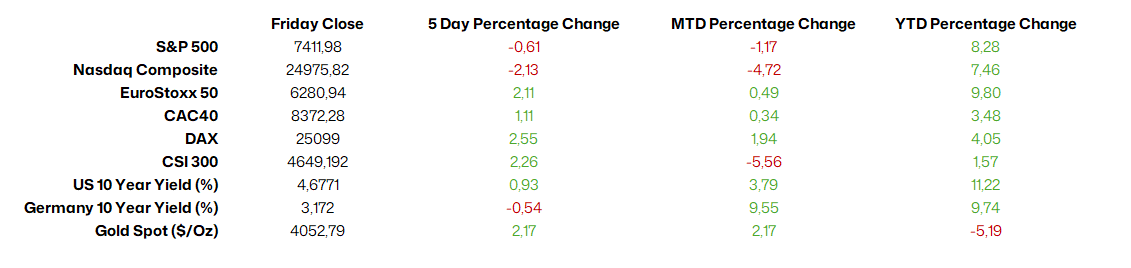
Amid these geopolitical concerns, as well as questions about the ROI of heavy AI investments, most US equity markets finished the week lower. In contrast, European stocks – particularly on the German index - managed to finish slightly higher on sturdy corporate earnings.
Source: Bloomberg, BIL as of 27 July 2026
Macro Snapshot
ECB keeps rates on hold after June's surprise hike
The European Central Bank left its three key interest rates unchanged on Thursday, keeping the deposit rate at 2.25%. The decision was widely expected and caused little movement in markets. It came just six weeks after the ECB raised rates by a quarter point in June, its first increase in almost three years, a move prompted by the jump in energy prices that followed the escalation of the war in the Middle East. Since then, the picture has improved a little: eurozone inflation slowed to 2.8% in June from 3.2% in May, the first decline this year, while core inflation (which excludes volatile categories such as food and energy) eased to 2.4%. President Christine Lagarde kept to a cautious message, repeating that the Governing Council will decide meeting by meeting, will stay guided by the incoming data, and is not committing to any particular path for rates. Energy prices remain volatile and sit well above pre-conflict levels, but the ECB judged them to be broadly in line with the assumptions behind its June projections. In short, having acted in June, policymakers appear content to wait and see how the energy shock and their earlier rate rise feed through to the economy. For now, the main question is no longer whether the ECB will start cutting, but whether renewed pressure from energy prices could push it to tighten again later in the year.
Investor sentiment brightens in Germany and the euro area
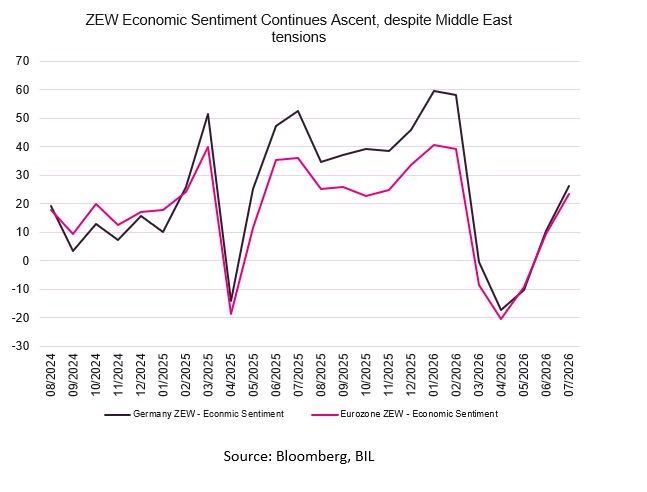
Germany's ZEW Indicator of Economic Sentiment rose to 26.3 in July, up from 10.5 in June and well above forecasts of 18, reaching its highest level since February, before the Middle East conflict weighted on global confidence. The improvement suggests that the government`s reform package is beginning to bolster the outlook. The report also revealed stronger expectations for export-oriented industries and resilient domestic demand, although the conflict in Iran and higher oil prices pose a risk to the recovery.
Sentiment across the wider euro area improved as well: the indicator climbed to 23.4 in July, up from 9.5 in June and well above expectations of around 11, extending a sharp recovery from the April low. Still, the recovery rests on fragile ground; renewed tensions or a prolonged disruption in the Strait of Hormuz could quickly reverse these gains. 64% of analysts expected stable activity, while 29.7% anticipated an improvement and 6.3% expected conditions to worsen.
Private sector activity rebounds on both sides of the Atlantic
PMI data was on the same page as the ZEW findings. Business activity in the eurozone picked up more than expected at the start of the third quarter, with the flash composite PMI, an early read on private-sector output across manufacturing and services, rising to 51.6 in July, a five-month high, comfortably above the 50 mark that separates growth from contraction. The reading beat expectations, as economists had looked for a figure close to 50, and it was led by a strong month for manufacturing, where output grew at its fastest pace since 2022. Encouragingly, Germany returned to growth after three months of contraction, with its composite index climbing to 51.2 from 49.5. Taken as a whole, the survey points to the eurozone economy expanding at a modest quarterly pace of around 0.3%, a welcome sign after a largely stagnant second quarter, although the recent flare-up in energy prices leaves the recovery far from assured.
The US Composite PMI also accelerated in July, reaching 53.6, up from 51.9 in June, and its highest level since November. Growth was driven by the services sector, where business activity accelerated to an 8-month high, in part thanks to temporary factors such as the FIFA World Cup, as well as celebrations marking the 250th birthday of the US. Manufacturing output continued to expand but at a much slower pace, with factories reporting the weakest increases in production since March. Inflation remains a red flag: input costs accelerated to a 14-month high and selling price inflation approached a 4-year peak.
This PMI was the last major reading on activity before the Federal Reserve's meeting on 29 July.
Calendar for the week ahead
Monday – Eurozone M3 Money Supply. Germany IFO Business Climate. US Durable Goods Orders.
Tuesday – France Consumer Confidence and Jobseekers data. Spain Unemployment and Retail Sales. US House Price Index, Conference Board Consumer Confidence.
Wednesday – US Federal Reserve Monetary Policy Meeting.
Thursday – Japan Consumer Confidence. Eurozone GDP Growth (Preliminary, Q2). Spain Inflation (Preliminary, July) and Business Confidence. Bank of England Monetary Policy Committee. Germany Inflation (Preliminary, July). US Personal Income and Spending (June), GDP Growth (Preliminary, Q2), PCE Index (June), Weekly Jobless Claims.
Friday – China NBS PMI (July). Bank of Japan Monetary Policy Meeting. France Inflation (Preliminary, July). Germany Unemployment Rate (July). Eurozone Inflation (Flash, July). Michigan Consumer Sentiment (Final, July).
Sunday – OPEC and Non-OPEC Ministerial Meeting
Disclaimer
All financial data and/or economic information released by this Publication (the “Publication”); (the “Data” or the “Financial data
and/or economic information”), are provided for information purposes only,
without warranty of any kind, including without limitation the warranties of merchantability, fitness for a particular
purpose or warranties and non-infringement of any patent, intellectual property or proprietary rights of any party, and
are not intended for trading purposes. Banque Internationale à Luxembourg SA (the “Bank”) does not guarantee expressly or
impliedly, the sequence, accuracy, adequacy, legality, completeness, reliability, usefulness or timeless of any Data.
All Financial data and/or economic information provided may be delayed or may contain errors or be incomplete.
This disclaimer applies to both isolated and aggregate uses of the Data. All Data is provided on an “as is” basis. None of
the Financial data and/or economic information contained on this Publication constitutes a solicitation, offer, opinion, or
recommendation, a guarantee of results, nor a solicitation by the Bank of an offer to buy or sell any security, products and
services mentioned into it or to make investments. Moreover, none of the Financial data and/or economic information contained on
this Publication provides legal, tax accounting, financial or investment advice or services regarding the profitability or
suitability of any security or investment. This Publication has not been prepared with the aim to take an investor’s particular investment objectives,
financial position or needs into account. It is up to the investor himself to consider whether the Data contained herein this
Publication is appropriate to his needs, financial position and objectives or to seek professional independent advice before making
an investment decision based upon the Data. No investment decision whatsoever may result from solely reading this document. In order
to read and understand the Financial data and/or economic information included in this document, you will need to have knowledge and
experience of financial markets. If this is not the case, please contact your relationship manager. This Publication is prepared by
the Bank and is based on data available to the public and upon information from sources believed to be reliable and accurate, taken from
stock exchanges and third parties. The Bank, including its parent,- subsidiary or affiliate entities, agents, directors, officers,
employees, representatives or suppliers, shall not, directly or indirectly, be liable, in any way, for any: inaccuracies or errors
in or omissions from the Financial data and/or economic information, including but not limited to financial data regardless of the
cause of such or for any investment decision made, action taken, or action not taken of whatever nature in reliance upon any Data
provided herein, nor for any loss or damage, direct or indirect, special or consequential, arising from any use of this Publication
or of its content. This Publication is only valid at the moment of its editing, unless otherwise specified. All Financial data and/or
economic information contained herein can also quickly become out-of- date. All Data is subject to change without notice and may not be
incorporated in any new version of this Publication. The Bank has no obligation to update this Publication upon the availability of new data,
the occurrence of new events and/or other evolutions. Before making an investment decision, the investor must read carefully the terms and
conditions of the documentation relating to the specific products or services. Past performance is no guarantee of future performance.
Products or services described in this Publication may not be available in all countries and may be subject to restrictions in some persons
or in some countries. No part of this Publication may be reproduced, distributed, modified, linked to or used for any public or commercial
purpose without the prior written consent of the Bank. In any case, all Financial data and/or economic information provided on this Publication
are not intended for use by, or distribution to, any person or entity in any jurisdiction or country where such use or distribution would be
contrary to law and/or regulation. If you have obtained this Publication from a source other than the Bank website, be aware that electronic
documentation can be altered subsequent to original distribution.
As economic conditions are subject to change, the information and opinions presented in this outlook are current only as of the date
indicated in the matrix or the publication date. This publication is based on data available to the public and upon information that is
considered as reliable. Even if particular attention has been paid to its content, no guarantee, warranty or representation is given to the
accuracy or completeness thereof. Banque Internationale à Luxembourg cannot be held liable or responsible with respect to the information
expressed herein. This document has been prepared only for information purposes and does not constitute an offer or invitation to make investments.
It is up to investors themselves to consider whether the information contained herein is appropriate to their needs and objectives or to seek advice
before making an investment decision based upon this information. Banque Internationale à Luxembourg accepts no liability whatsoever for any investment
decisions of whatever nature by the user of this publication, which are in any way based on this publication, nor for any loss or damage arising
from any use of this publication or its content. This publication, prepared by Banque Internationale à Luxembourg (BIL), may not be copied or
duplicated in any form whatsoever or redistributed without the prior written consent of BIL 69, route d’Esch ı L-2953 Luxembourg ı
RCS Luxembourg B-6307 ı Tel. +352 4590 6699 ı www.bil.com.
Read more
More
August 17, 2026
Weekly Investment Insights
US Treasury markets were in focus last week as investors demanded higher compensation to absorb growing government borrowing needs. A $42 billion auction of...
August 10, 2026
Weekly InsightsWeekly Investment Insights
Last week, the S&P 500 surpassed USD 70 trillion in total market cap for the first time in history, while the technology-heavy Nasdaq recorded its...
August 7, 2026
BILBoardBILBoard August 2026 – Partial Eclipse
A solar eclipse will occur in Luxembourg on 12 August, with around 90% of the Sun covered shortly before sunset. The global economy also...
August 3, 2026
Weekly InsightsWeekly Investment Insights
Markets faced three overlapping headwinds last week: concerns about the profitability of AI investments, renewed tensions in the Middle East, and uncertainty surrounding the...