
BIL INVESTMENT INSIGHTS

Thanksgiving meant that last week was cut short for the US stock market, but that did not stop major indices from ending the week higher. Optimism about a potential interest rate cut by the Fed in December boosted the market. The Nasdaq recovered from the previous week’s sell-off, during which investors took some chips off the table due to fears about high valuations, as attention turned to the upcoming FOMC meeting on 10 December.
A UK gilts rally brought the 30-yr to the lowest levels since June this year as the newly announced Autumn Budget somewhat eased concerns for long-term bonds by instating a much bigger fiscal headroom. In addition, a planned reduction of long-term gilt issuance by the UK government, also helped push yields lower.
Macro Snapshot
Can Trump spare US consumption?
Data released last week showed US consumer spending slowed at the end of Q3. Retail sales grew 0.2% MoM in September – the smallest increase in four months and only half of the +0.4% expected by economists.
Miscellaneous store retailers and gas stations saw the strongest spending, while sales fell quite markedly at sports, clothing and book stores.
Core retail sales, which are used to calculate GDP, declined 0.1%. Nonetheless, consumption is still on track to make a solid contribution to Q3 growth statistics, given that real spending was robust in July and August.
The path from here is, however, less certain. The outlook has been further dashed by a dismal consumer sentiment reading from the Conference Board. Its gauge plummeted from 95.5 to 88.7 last week, with households increasingly pessimistic about the labour market and future income streams. The unemployment rate recently reached a four-year high of 4.4%, while wage growth continues its downward trend.
Sticky inflation is exacerbating the gloom. Cognizant of this, the Trump Administration has been actively trying to lower grocery prices by striking trade deals with several Latin American countries, covering items such as coffee and beef. At the annual Thanksgiving turkey pardoning ceremony, President Trump said, “This Thanksgiving, we’re also making incredible strides to make America affordable again.”
A fresh CBS News/YouGov survey* revealed that 36% of Americans approve of Trump’s handling of the economy, down from 51% in a poll conducted early March. The drop in economic approval is steeper than the overall decline: Today, 40% of Americans approve of Trump’s performance in office, down 11 points from the March survey.
Trump spared a turkey. But the most pressing issue now is whether he will be able to keep consumption alive ahead of the midterm elections. Household spending is the driving force behind the US economy, accounting roughly two-thirds of overall activity.
*The survey included 1,489 adults and was conducted Nov. 19-21.
UK Autumn Budget raises taxes by £26bn
Following the accidental early leak of the Office for Budget Responsibility's outlook on Wednesday, Chancellor Rachel Reeves finally unveiled her second Autumn Budget. This will increase taxes by around £26 billion and boost her fiscal headroom to £22 billion. The announced tax hikes will further squeeze household incomes at a time when British households are already struggling with high inflation and a weakening labour market. However, not all of the tax increases will be implemented right away, and they will come into force over the coming years. Many of the most significant personal tax changes will not take effect until 2028.
The main policy announcements in the budget include:
- A freeze on the personal income tax threshold until 2030-31.
- Salary sacrifice pension contributions to be capped at £2 000 a year before national insurance applies.
- A 2% tax increase on dividends, savings and property income.
- Council tax surcharge on homes worth more than £2mn from April 2028.
- Two-child benefit cap
- Cash Isa allowance for those under the age of 65 to be cut from £20 000 to £12 000, as of April 2027. Over-65s will retain the existing allowance.
- A 3p pay-per-mile tax on electric vehicles.
- Online gaming tax to rise from 21 to 40%, and the levy on online sports betting will increase from 15 to 25%.
- Fuel duty rates frozen until September 2026.
These measures are expected to increase the tax take to an all-time high of 38% of GDP in 2030-31.
The enlarged tax revenue should offset the additional spending of £11.3 billion included in the budget to fund the reversal of welfare cuts made over the summer and the lifting of the two-child benefit cap. However, the OBR has warned that the Chancellor’s margin for error is still small. Several tax hikes are only set to be implemented in the next few years, meaning spending will increase sharply now while much of the tax revenue will only come in later.
In its outlook, the OBR also updated its economic forecasts for 2025 and 2026. Stronger growth than expected is foreseen for this year, but growth in 2026 was downgraded. Inflation is also expected to remain stickier than initially expected.
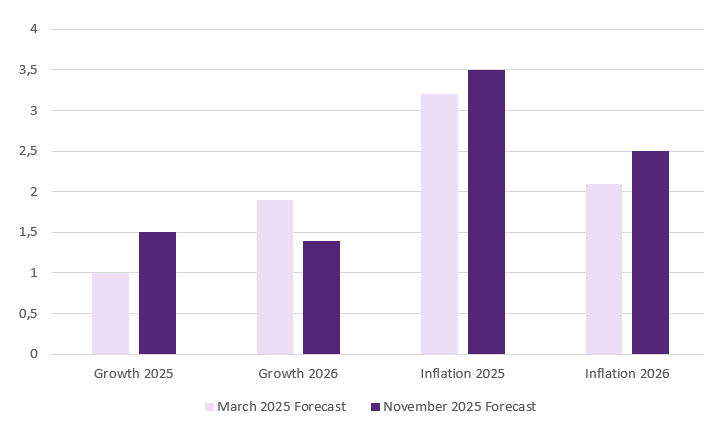
Source: OBR, BIL
The OBR also forecasts that the productivity outlook will be 1% over the medium term, 0.3 percentage points below the March estimate.
UK stocks fell on the announcement as market participants anticipate weaker growth.
Chinese manufacturers continue to struggle despite trade deal with the US
According to Beijing’s official manufacturing PMI, China’s factory activity continued to contract in November, albeit at a slower pace, with the index rising to 49.2, up from 49 in October. This marks the eighth consecutive month of contraction, despite the easing of trade tensions in November following the deal struck between the US and China. Manufacturers are still facing weak demand, intense domestic price competition, and global trade uncertainty. According to a private sector PMI (RatingDog), the manufacturing index contracted again after three months of expansion, with new orders stagnating amid job cuts and subdued demand.
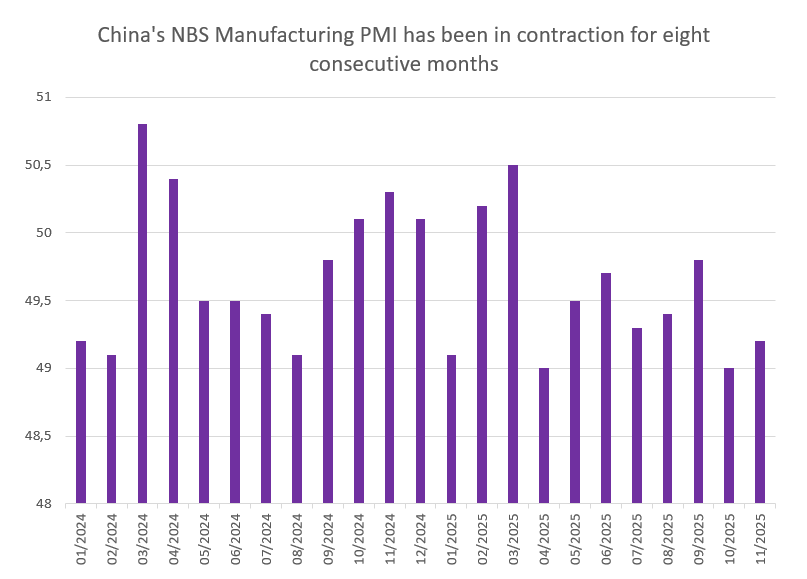
Source: Bloomberg, BIL
Calendar for the week ahead
Monday – Switzerland Retail Sales (October), Manufacturing PMI (November). Eurozone, US, UK, France & Germany Manufacturing PMI (November, Final). US ISM Manufacturing PMI (November).
Tuesday – Japan Consumer Confidence (November). UK Housing Prices (November). Eurozone Inflation Rate (Flash, November), Unemployment Rate (October).
Wednesday – Switzerland Inflation Rate (November). Eurozone, France, Germany, UK & US Composite & Services PMI (Final, November). US ISM Services PMI (November).
Thursday – Switzerland Unemployment Rate (November). Eurozone Retail Sales (October). US Challenger Job Cuts (November), Jobless Claims.
Friday – Germany Factory Orders (October). Eurozone GDP Growth Rate (Final, Q3). US Michigan Consumer Sentiment (Prel, December).
Disclaimer
All financial data and/or economic information released by this Publication (the “Publication”); (the “Data” or the “Financial data
and/or economic information”), are provided for information purposes only,
without warranty of any kind, including without limitation the warranties of merchantability, fitness for a particular
purpose or warranties and non-infringement of any patent, intellectual property or proprietary rights of any party, and
are not intended for trading purposes. Banque Internationale à Luxembourg SA (the “Bank”) does not guarantee expressly or
impliedly, the sequence, accuracy, adequacy, legality, completeness, reliability, usefulness or timeless of any Data.
All Financial data and/or economic information provided may be delayed or may contain errors or be incomplete.
This disclaimer applies to both isolated and aggregate uses of the Data. All Data is provided on an “as is” basis. None of
the Financial data and/or economic information contained on this Publication constitutes a solicitation, offer, opinion, or
recommendation, a guarantee of results, nor a solicitation by the Bank of an offer to buy or sell any security, products and
services mentioned into it or to make investments. Moreover, none of the Financial data and/or economic information contained on
this Publication provides legal, tax accounting, financial or investment advice or services regarding the profitability or
suitability of any security or investment. This Publication has not been prepared with the aim to take an investor’s particular investment objectives,
financial position or needs into account. It is up to the investor himself to consider whether the Data contained herein this
Publication is appropriate to his needs, financial position and objectives or to seek professional independent advice before making
an investment decision based upon the Data. No investment decision whatsoever may result from solely reading this document. In order
to read and understand the Financial data and/or economic information included in this document, you will need to have knowledge and
experience of financial markets. If this is not the case, please contact your relationship manager. This Publication is prepared by
the Bank and is based on data available to the public and upon information from sources believed to be reliable and accurate, taken from
stock exchanges and third parties. The Bank, including its parent,- subsidiary or affiliate entities, agents, directors, officers,
employees, representatives or suppliers, shall not, directly or indirectly, be liable, in any way, for any: inaccuracies or errors
in or omissions from the Financial data and/or economic information, including but not limited to financial data regardless of the
cause of such or for any investment decision made, action taken, or action not taken of whatever nature in reliance upon any Data
provided herein, nor for any loss or damage, direct or indirect, special or consequential, arising from any use of this Publication
or of its content. This Publication is only valid at the moment of its editing, unless otherwise specified. All Financial data and/or
economic information contained herein can also quickly become out-of- date. All Data is subject to change without notice and may not be
incorporated in any new version of this Publication. The Bank has no obligation to update this Publication upon the availability of new data,
the occurrence of new events and/or other evolutions. Before making an investment decision, the investor must read carefully the terms and
conditions of the documentation relating to the specific products or services. Past performance is no guarantee of future performance.
Products or services described in this Publication may not be available in all countries and may be subject to restrictions in some persons
or in some countries. No part of this Publication may be reproduced, distributed, modified, linked to or used for any public or commercial
purpose without the prior written consent of the Bank. In any case, all Financial data and/or economic information provided on this Publication
are not intended for use by, or distribution to, any person or entity in any jurisdiction or country where such use or distribution would be
contrary to law and/or regulation. If you have obtained this Publication from a source other than the Bank website, be aware that electronic
documentation can be altered subsequent to original distribution.
As economic conditions are subject to change, the information and opinions presented in this outlook are current only as of the date
indicated in the matrix or the publication date. This publication is based on data available to the public and upon information that is
considered as reliable. Even if particular attention has been paid to its content, no guarantee, warranty or representation is given to the
accuracy or completeness thereof. Banque Internationale à Luxembourg cannot be held liable or responsible with respect to the information
expressed herein. This document has been prepared only for information purposes and does not constitute an offer or invitation to make investments.
It is up to investors themselves to consider whether the information contained herein is appropriate to their needs and objectives or to seek advice
before making an investment decision based upon this information. Banque Internationale à Luxembourg accepts no liability whatsoever for any investment
decisions of whatever nature by the user of this publication, which are in any way based on this publication, nor for any loss or damage arising
from any use of this publication or its content. This publication, prepared by Banque Internationale à Luxembourg (BIL), may not be copied or
duplicated in any form whatsoever or redistributed without the prior written consent of BIL 69, route d’Esch ı L-2953 Luxembourg ı
RCS Luxembourg B-6307 ı Tel. +352 4590 6699 ı www.bil.com.
Read more
More
October 8, 2026
BILBoardBIL Board October 2026 – Long-T...
Global bond markets have come under pressure in recent months, pushing long-term yields sharply higher. The US 10-year Treasury yield, potentially one of the most...
October 6, 2026
NewsEurozone Inflation… energy impa...
The Eurozone has so far weathered the energy shock surprisingly well. Yet beneath the surface, rising fuel costs, weaker fiscal support and resilient growth suggest...
October 2, 2026
Weekly Investment Insights
Posted as of midday 2nd October. Thank you for your continued readership. Please note that our weekly insights will pause throughout October, resuming 2nd...
September 28, 2026
Weekly InsightsWeekly Investment Insights
After a volatile week in which stronger-than-expected PMI data fuelled concerns over persistent inflation and higher interest rates, US equities still managed to finish in...
September 21, 2026
Weekly InsightsWeekly Investment Insights
Equities came under pressure at the beginning of last week after leading voices in the AI industry called for a slower pace of technological...