
BIL INVESTMENT INSIGHTS

Posted as of midday 2nd October.
Thank you for your continued readership. Please note that our weekly insights will pause throughout October, resuming 2nd November.
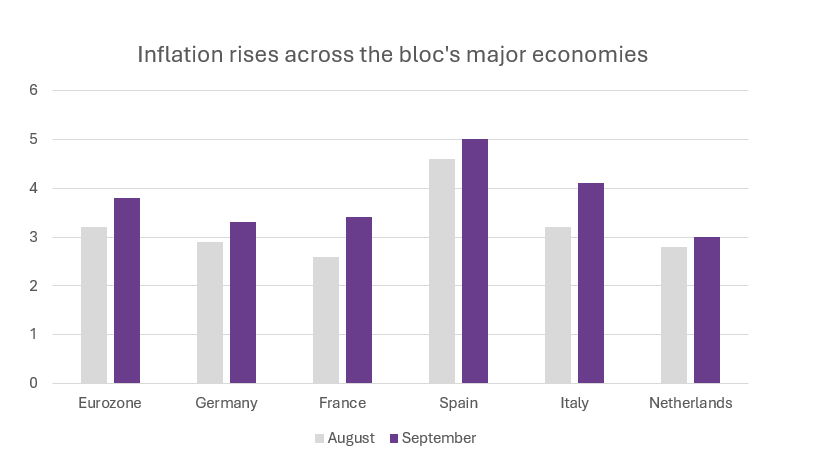
A sharp sell-off in global bond markets pushed sovereign borrowing costs to multi-decade highs, as investors grappled with the combined impact of higher inflation, rising energy prices and worsening fiscal outlooks. US Treasury yields surged, with the 10-year yield reaching 5.34%, its highest level since 2002, while UK 30-year gilt yields briefly climbed above 6% for the first time since 1998. European bond markets also came under pressure, with France's 10-year government bond yield flirting with 5%, a level not seen in almost a quarter of a century. Inflation data from major European economies surprised to the upside, reinforcing concerns that the global energy supply shock could feed into broader price pressures, thereby increasing the likelihood of further monetary tightening.
Rising government bond yields weighed on equity markets on both sides of the Atlantic, although technology and AI-related companies proved somewhat resilient, supported by strong earnings expectations.
Concerns about fiscal sustainability became particularly pronounced in France, with the spread between French and German government bond yields widened to its highest level since the Euro-Area debt crisis. The French government's latest budget aims to reduce the deficit through a combination of spending cuts and tax increases, but proposals have already been met with student protests across the country. The deficit is expected to remain above 5% of GDP for a fourth consecutive year, while debt-servicing costs are projected to rise sharply, exceeding spending on key areas such as education and defence. The European Union has a 3% deficit ceiling.
More broadly, the bond market turmoil highlights a growing challenge for governments worldwide. Years of higher borrowing, coupled with rising interest rates, are translating into substantially larger debt-servicing costs at a time when energy-related pressures continue to weigh on households and businesses. According to the OECD’s latest Global Debt Report, 78% of total borrowing by OECD governments in 2026 is projected to go toward refinancing existing debt rather than funding new government spending. With sovereign yields in the US, UK, France and Japan all hovering around levels not seen in decades, investors are increasingly demanding greater compensation for fiscal and inflation risks, creating a more challenging environment for both policymakers and financial markets.
Macro Snapshot
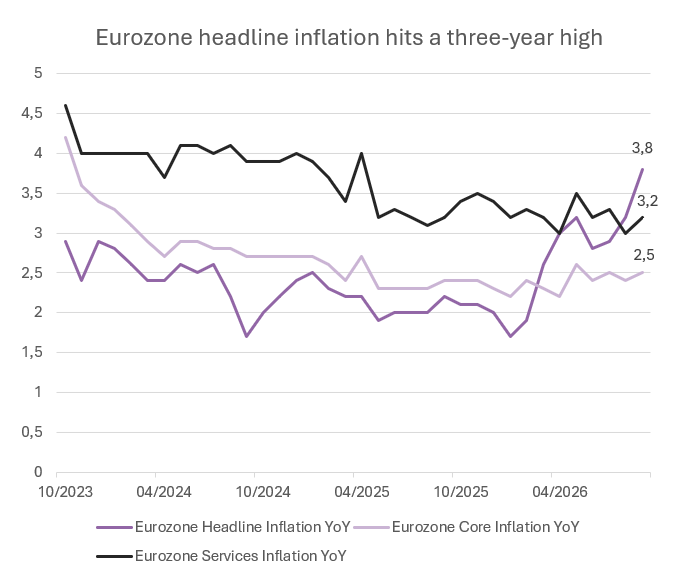
Energy costs continue to pressure Eurozone inflation upwards
Eurozone inflation accelerated sharply in September, underscoring the growing economic impact of higher energy prices. According to flash estimates, annual inflation rose to 3.8%, up from 3.2% in August and above market expectations of 3.6%. The increase was driven primarily by energy costs, with energy inflation surging to 18.8%, the strongest reading since January 2023, amid ongoing conflict in the Middle East. Price pressures also intensified in services and unprocessed food, while core inflation edged up to 2.5%, as expected.
The energy shock is becoming increasingly pertinent. Several European countries have reportedly entered discussions over the potential release of diesel reserves, following pressure from the US administration. European governments are finding it more difficult to shield households and businesses given already stretched public finances and rising borrowing costs. The ECB remains focused on preventing higher energy prices from feeding into broader inflation through stronger wage demands and corporate pricing decisions. As a result, policymakers are expected to tighten monetary policy further in the coming months, although expectations for an immediate rate increase have moderated. ECB President Christine Lagarde recently commented that higher yields should help slow economic activity and reduce the risk of energy-driven inflation becoming entrenched.
 Source: Bloomberg, BIL
Source: Bloomberg, BIL
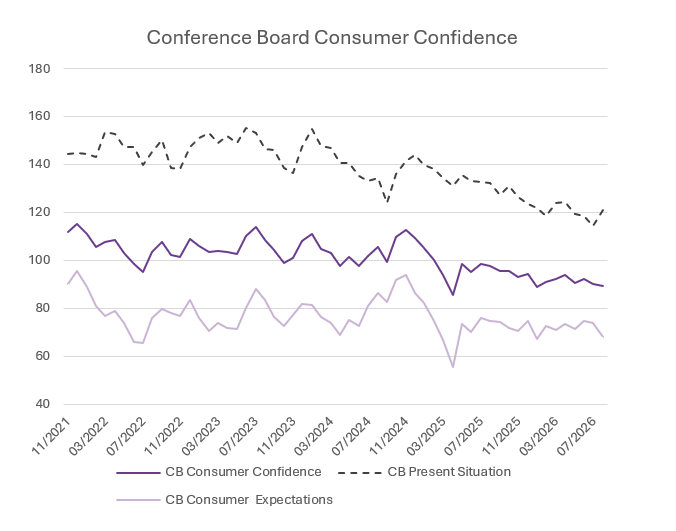
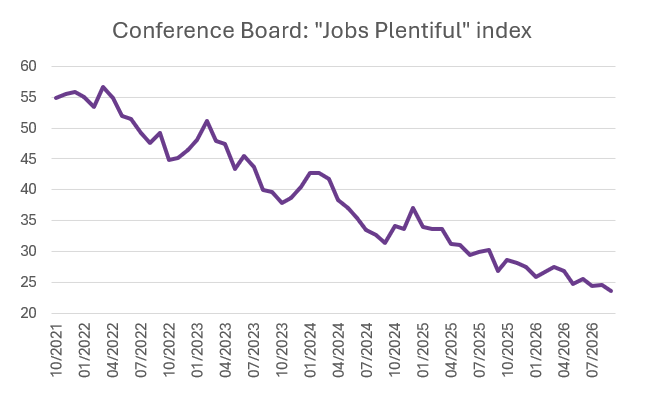
US consumer confidence hits lowest level since 2014
US consumer confidence weakened significantly in September, highlighting growing pressure on household sentiment as inflation remains elevated. The Conference Board's Consumer Confidence Index fell to 81.9, its lowest level since 2014, down from 88.6 in August and well below economists' expectations of 89. Much of the deterioration appears linked to persistent inflation and rising energy costs, with concerns about gasoline prices featuring prominently in survey responses. At around $4.50 per gallon nationally, fuel prices are more than a dollar higher than a year ago, weighing on household budgets in a country heavily reliant on car travel.
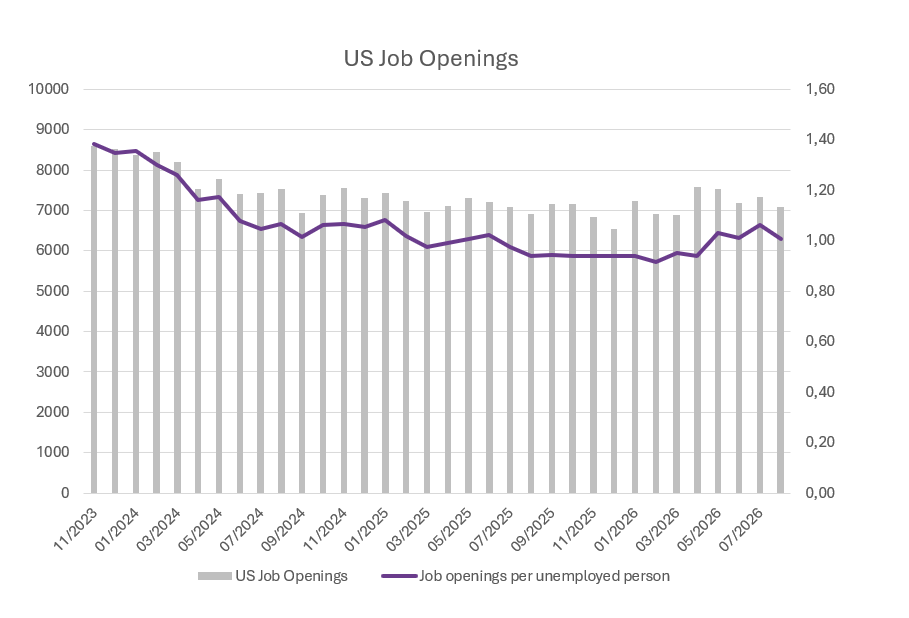
Looking ahead, consumers have become increasingly cautious. The expectations component of the survey dropped to 63.6 from 69.5 in August, falling well below the 80 threshold that has historically been associated with recession risks. While the strength of higher-income households and ongoing wealth effects may distort traditional recession signals, the decline nevertheless points to growing unease about the economic outlook. Consumers also reported a less favourable view of labour market conditions, a trend echoed by separate data showing job openings fell by 256,000 to 7.1 million, their lowest level in five months. Together, the latest figures suggest that higher living costs and a gradually cooling labour market are beginning to weigh more heavily on the US consumer, a key driver of economic growth.
Source: Bloomberg, BIL
Source: Bloomberg, BIL
Source: Bloomberg, BIL
China’s industrial profits slow further
China’s industrial profits grew at their weakest pace this year, expanding just 4.2% YoY in August. It was the most tepid pace of profit growth since November last year, with the auto sector being a major drag. Profits therein dropped by 16% YoY amid intense competition. Consumer sectors also lagged, while the tech sector continues to soar. Profits in the computer, communication and electronic equipment manufacturing industry more than doubled for the January-to-August period, rising 110% from a year earlier. According to reports, one of the country’s most important political gatherings, the fifth plenary session of the party’s 20th Central Committee, will be held from October 26-29. At this meeting, we might expect Beijing to provide high-level announcements that set policy direction. Stronger language on supporting consumption or stabilising growth would likely be perceived favourably by markets.
Calendar for the week ahead
Monday – BoJ Monetary Policy Meeting Minutes. China Industrial Profits.
Tuesday – Spain Inflation (Preliminary, September), Retail Sales and Business Confidence. Italy Industrial Sales and PPI. Eurozone Economic Sentiment, Consumer Confidence. France Unemployment. US JOLTs Job Openings, Conference Board Consumer Confidence and House Price Index
Wednesday – Japan Retail Sales and Industrial Production. China PMI. Germany Retail Sales and Unemployment. France Inflation Rate (Preliminary, September). Italy Business and Consumer Confidence, Inflation (Preliminary, September). Germany Inflation (Preliminary, September). US GDP Growth (Final, Q2), Personal Income and Spending (August).
Thursday – Japan Tankan Index (Q3), BoJ Summary of Opinions. Eurozone PMI (Final, September). Eurozone, UK Unemployment Rate. France OAT Auction. US Weekly Jobless Claims, ISM Manufacturing PMI (September).
Friday – Japan Consumer Confidence. Eurozone Inflation (Flash, September). Italy Retail Sales. US Nonfarm Payrolls, Unemployment and Average Hourly Earnings.
Sunday – Brazil General Elections. OPEC and non-OPEC Ministerial Meeting.
Disclaimer
All financial data and/or economic information released by this Publication (the “Publication”); (the “Data” or the “Financial data
and/or economic information”), are provided for information purposes only,
without warranty of any kind, including without limitation the warranties of merchantability, fitness for a particular
purpose or warranties and non-infringement of any patent, intellectual property or proprietary rights of any party, and
are not intended for trading purposes. Banque Internationale à Luxembourg SA (the “Bank”) does not guarantee expressly or
impliedly, the sequence, accuracy, adequacy, legality, completeness, reliability, usefulness or timeless of any Data.
All Financial data and/or economic information provided may be delayed or may contain errors or be incomplete.
This disclaimer applies to both isolated and aggregate uses of the Data. All Data is provided on an “as is” basis. None of
the Financial data and/or economic information contained on this Publication constitutes a solicitation, offer, opinion, or
recommendation, a guarantee of results, nor a solicitation by the Bank of an offer to buy or sell any security, products and
services mentioned into it or to make investments. Moreover, none of the Financial data and/or economic information contained on
this Publication provides legal, tax accounting, financial or investment advice or services regarding the profitability or
suitability of any security or investment. This Publication has not been prepared with the aim to take an investor’s particular investment objectives,
financial position or needs into account. It is up to the investor himself to consider whether the Data contained herein this
Publication is appropriate to his needs, financial position and objectives or to seek professional independent advice before making
an investment decision based upon the Data. No investment decision whatsoever may result from solely reading this document. In order
to read and understand the Financial data and/or economic information included in this document, you will need to have knowledge and
experience of financial markets. If this is not the case, please contact your relationship manager. This Publication is prepared by
the Bank and is based on data available to the public and upon information from sources believed to be reliable and accurate, taken from
stock exchanges and third parties. The Bank, including its parent,- subsidiary or affiliate entities, agents, directors, officers,
employees, representatives or suppliers, shall not, directly or indirectly, be liable, in any way, for any: inaccuracies or errors
in or omissions from the Financial data and/or economic information, including but not limited to financial data regardless of the
cause of such or for any investment decision made, action taken, or action not taken of whatever nature in reliance upon any Data
provided herein, nor for any loss or damage, direct or indirect, special or consequential, arising from any use of this Publication
or of its content. This Publication is only valid at the moment of its editing, unless otherwise specified. All Financial data and/or
economic information contained herein can also quickly become out-of- date. All Data is subject to change without notice and may not be
incorporated in any new version of this Publication. The Bank has no obligation to update this Publication upon the availability of new data,
the occurrence of new events and/or other evolutions. Before making an investment decision, the investor must read carefully the terms and
conditions of the documentation relating to the specific products or services. Past performance is no guarantee of future performance.
Products or services described in this Publication may not be available in all countries and may be subject to restrictions in some persons
or in some countries. No part of this Publication may be reproduced, distributed, modified, linked to or used for any public or commercial
purpose without the prior written consent of the Bank. In any case, all Financial data and/or economic information provided on this Publication
are not intended for use by, or distribution to, any person or entity in any jurisdiction or country where such use or distribution would be
contrary to law and/or regulation. If you have obtained this Publication from a source other than the Bank website, be aware that electronic
documentation can be altered subsequent to original distribution.
As economic conditions are subject to change, the information and opinions presented in this outlook are current only as of the date
indicated in the matrix or the publication date. This publication is based on data available to the public and upon information that is
considered as reliable. Even if particular attention has been paid to its content, no guarantee, warranty or representation is given to the
accuracy or completeness thereof. Banque Internationale à Luxembourg cannot be held liable or responsible with respect to the information
expressed herein. This document has been prepared only for information purposes and does not constitute an offer or invitation to make investments.
It is up to investors themselves to consider whether the information contained herein is appropriate to their needs and objectives or to seek advice
before making an investment decision based upon this information. Banque Internationale à Luxembourg accepts no liability whatsoever for any investment
decisions of whatever nature by the user of this publication, which are in any way based on this publication, nor for any loss or damage arising
from any use of this publication or its content. This publication, prepared by Banque Internationale à Luxembourg (BIL), may not be copied or
duplicated in any form whatsoever or redistributed without the prior written consent of BIL 69, route d’Esch ı L-2953 Luxembourg ı
RCS Luxembourg B-6307 ı Tel. +352 4590 6699 ı www.bil.com.
Read more