
BIL INVESTMENT INSIGHTS

US Treasury markets were in focus last week as investors demanded higher compensation to absorb growing government borrowing needs. A $42 billion auction of 10-year Treasuries cleared at 4.683%, the highest yield since 2007, while a subsequent sale of 30-year bonds priced at 5.216%, the highest level in a quarter century. Both auctions attracted solid investor demand, suggesting that higher yields continue to draw buyers.
Fiscal concerns remain at the forefront. The US recorded a record July budget deficit of $432 billion, bringing the cumulative deficit for fiscal year 2026 to $1.8 trillion with two months still remaining. While Fitch reaffirmed the United States' AA+ credit rating this August, the agency projects the federal deficit to reach 7.4% of GDP in both 2026 and 2027, reinforcing concerns about the long-term sustainability of public finances.
Beyond fiscal dynamics, several factors continue to support elevated bond yields. The US economy remains resilient, while a heavy calendar of corporate bond issuance has intensified competition for investor capital. Geopolitical developments are also contributing to the inflation outlook. Brent crude moved higher towards the end of the week after the US threatened Iran with “economic isolation” , including continued restrictions linked to its ports. Traffic through the Strait of Hormuz remains very scant, and a return to normal oil flows looks unlikely in the near term.
Equity markets, however, found support from a combination of strong corporate earnings and softer macroeconomic data. Technology stocks rebounded following their July correction, buoyed by robust results from leading AI-related companies. At the same time, weaker-than-expected inflation, retail sales and consumer confidence figures led investors to scale back expectations of further Federal Reserve rate hikes, providing additional support for risk assets.
More broadly, the earnings season has highlighted the strength of the US corporate sector beyond the technology space. S&P 500 earnings growth accelerated to 34% YoY in the second quarter, up from 25% in Q1, marking one of the strongest periods of profit growth outside post-recession recoveries. While technology remains the largest contributor to earnings growth, its share has declined from roughly 90% a year ago to around 55% today, indicating that profit growth is becoming increasingly broad-based across sectors. This widening participation points to a healthy cyclical expansion and provides a constructive backdrop for equities despite ongoing fiscal and geopolitical challenges.
Market Snapshot
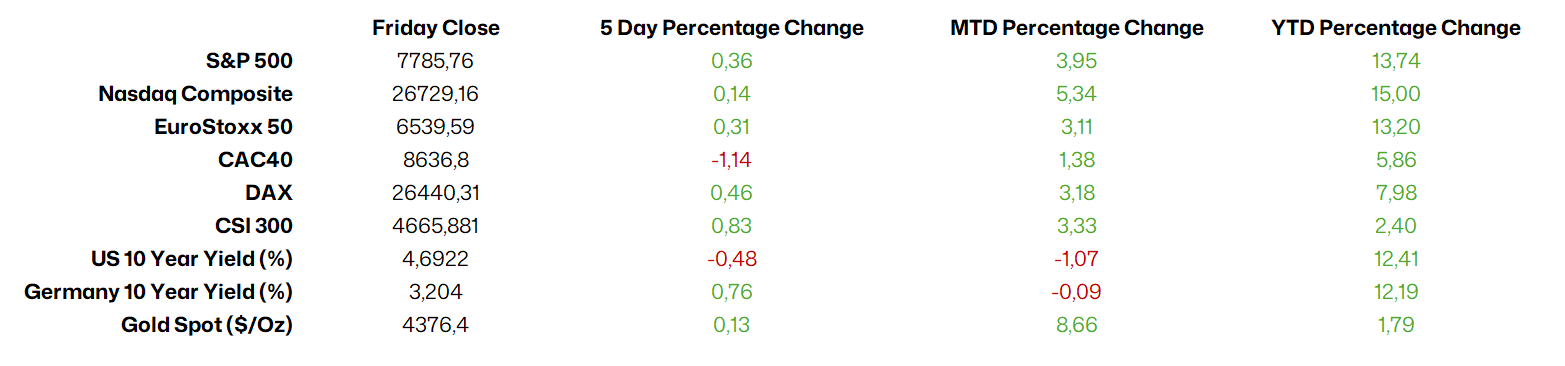
Source: Bloomberg, BIL as of 17/8/26
Macro Snapshot
US inflation continues to cool, albeit slowly
US inflation moderated further in July, with headline CPI slowing for a second consecutive month to 3.4% YoY. On a monthly basis, CPI increased 0.1%; shelter prices (+0.1%) accounted for roughly two-thirds of the increase, while energy prices fell 1.5% during the month. Food prices declined, notably due to a 16.4% plunge in lettuce prices, following a cyclospora outbreak.
Importantly, annual core inflation - which excludes food and fuel - eased to 2.5%, the lowest level in five months.
On the producer side, the PPI rose 4.7% YoY, down from 5.5% in June and marking its lowest level since March. Core PPI increased 0.2% month-on-month, slowing from a 0.4% pace in June and coming in below market expectations of 0.3%. On an annual basis, core producer inflation stood at 4.2%.
The moderation in both core CPI and PPI gives the Fed greater flexibility. Nevertheless, one more inflation report for August will be released before the Fed's September meeting, while ongoing geopolitical tensions in the Middle East continue to represent an important source of uncertainty.
Rhine shipping constraints resurface as water levels fall
Following this summer’s heatwaves and prolonged lack of rainfall, river levels on the Rhine have fallen sharply, forcing cargo vessels to operate at only a fraction of their normal capacity. To move the same volume of goods, cargo owners must distribute shipments across multiple partially-loaded vessels, significantly increasing transportation costs.
In response to the worsening situation, several German states have temporarily lifted Sunday driving restrictions for lorries to help mitigate supply chain disruptions. Rhine water levels now sit near record lows, with the Kaub bottleneck, the river's most critical shipping chokepoint, recording gauge levels of less than 20 centimetres of navigable clearance.
Parts of the Danube have also reached exceptionally low levels, forcing Hungarian authorities to implement emergency measures to maintain operations at the Paks nuclear power plant. The facility, which relies on water from the Danube to cool reactors, is currently operating at little more than 10% of its capacity because of low water levels. Paks supplies roughly one-third of Hungary's electricity.
As these rivers remain vital arteries for Europe, persistent low water levels could create supply chain bottlenecks, raise costs, and place renewed pressure on industrial production.
Eurozone industrial production was unchanged in June, according to data released on Thursday. On an annual basis, output increased by just 0.1%, underscoring the fragile state of the region's industrial sector.
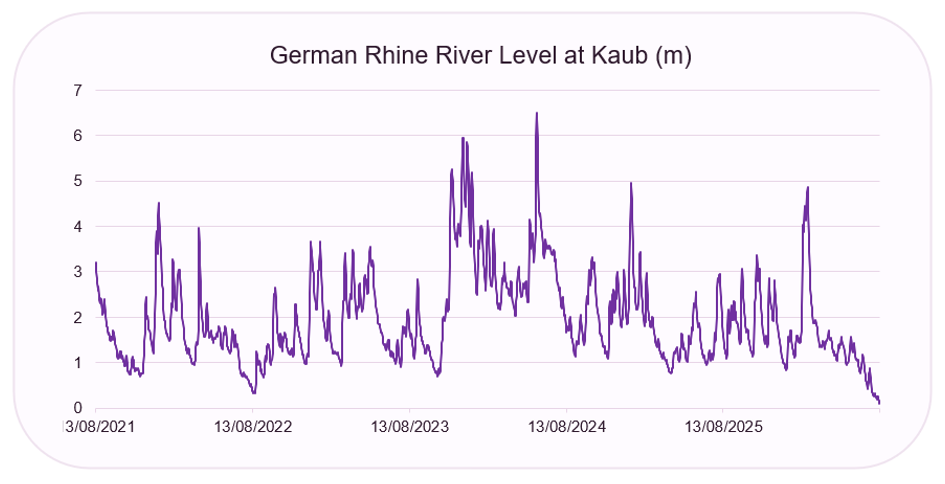
Source: Bloomberg, BIL. The chart shows the navigable clearance above a predetermined reference level.
US Small Business Optimism rises to a near 1-year high
Small businesses account for nearly half of US economic activity, making the NFIB Small Business Optimism Survey an important gauge of economic momentum. As one of the earliest monthly readings on Main Street conditions, the survey provides valuable insight into hiring, pricing and investment intentions, offering an early signal on growth, inflation and ultimately the direction of Fed policy.
The Index rose to 99.8 in July, its highest level since August last year, and up from 97.4 prior. Eight of the survey's ten components improved, led by a sharp increase in hiring intentions. A net 20% of business owners expect to create new jobs over the next three months, up nine percentage points from June and the highest reading since October 2022. Labour quality and availability remained the most frequently cited business concern.
Inflation signals were encouraging. Both actual and planned price increases eased from June, with the net share of firms raising average selling prices falling seven points to 31%, while the net share planning future price increases declined four points to 28%.
For investors, the survey points to resilient small business activity and paints a picture of a more robust labour market than last week’s nonfarm payroll report showed. At the same time, easing pricing intentions suggest inflation pressures may be moderating. The combination is broadly consistent with steady economic growth but a less concerning inflation backdrop.
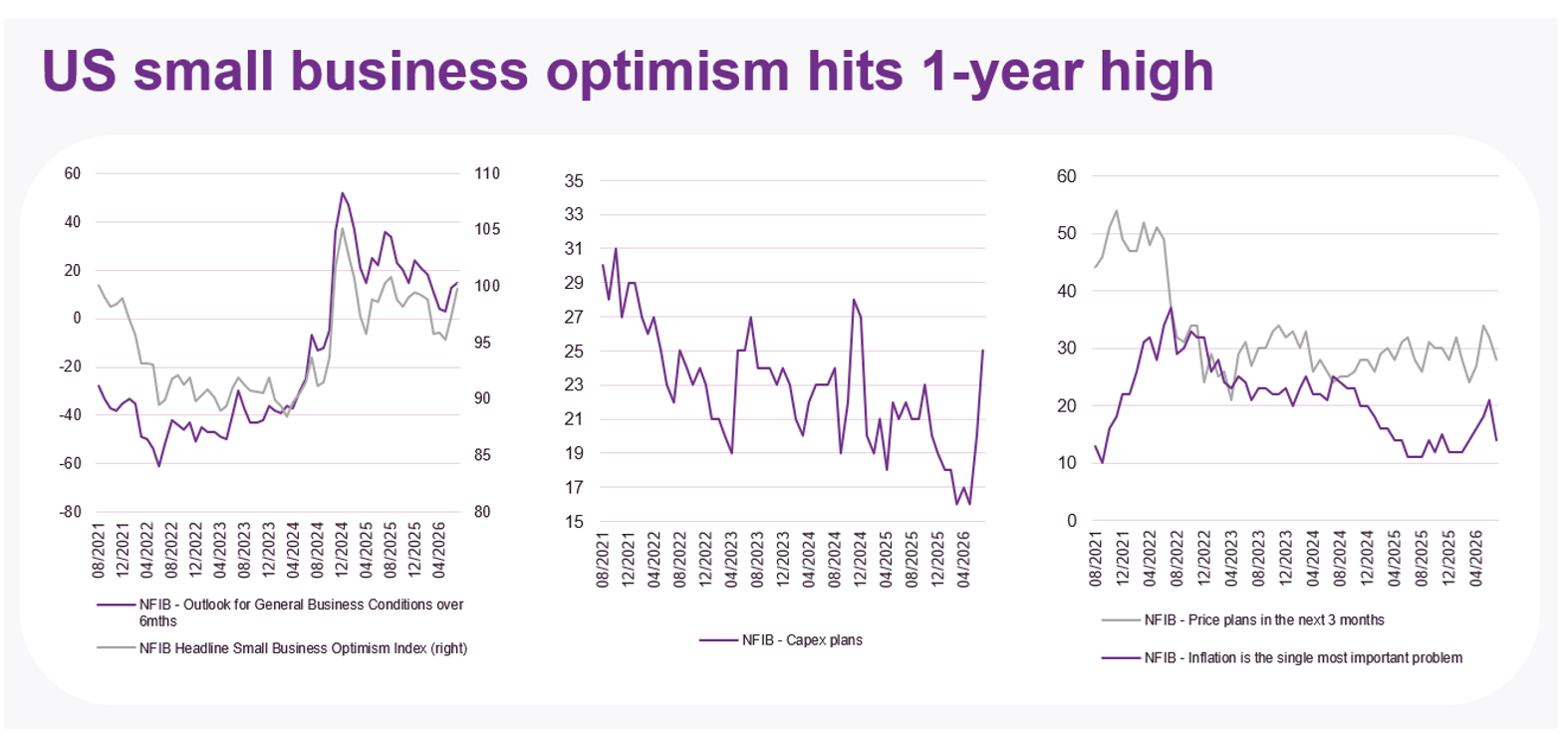
Source: Bloomberg, BIL
… but US Consumers are not riding the same wave of optimism
While Main Street is enjoying a rosier outlook, US consumers are not fully sharing in that optimism. Consumer spending lost momentum in July, raising fresh questions about the strength of household demand. Retail sales fell 0.6% MoM, significantly weaker than expectations for a 0.1% increase, marking the first decline since October 2025.
The weakness was led by non-store retailers (-2.2%), likely reflecting a cooldown after Amazon’s Prime Day boosted spending in June. Sales also declined at motor vehicle and parts dealers (-1.8%), gasoline stations (-0.9%) and electronics and appliance stores (-0.5%). The figures are not adjusted for inflation.
Core retail sales, which feed into GDP calculations, dropped 0.4%, the largest decline since the start of 2025.
There were, however, some pockets of resilience, especially for clothing and accessories. Spending at restaurants and bars, often viewed as a useful gauge of discretionary spending, increased 0.5% during the month, potentially supported by spending related to the FIFA World Cup, which ran through 19 July.
Consumer confidence also weakened. The University of Michigan Consumer Sentiment Index fell to 51.0 in August from 55.2 previously, well below expectations of 54.5. Notably, only 8% of consumers now expect their incomes to rise faster than inflation.
Taken together, the latest retail sales and sentiment data suggest that consumers are becoming increasingly cautious. While the labour market remains relatively healthy, softer spending patterns and declining confidence point to a gradual cooling in domestic demand, a development that could give the Federal Reserve additional room to remain patient on further policy tightening.
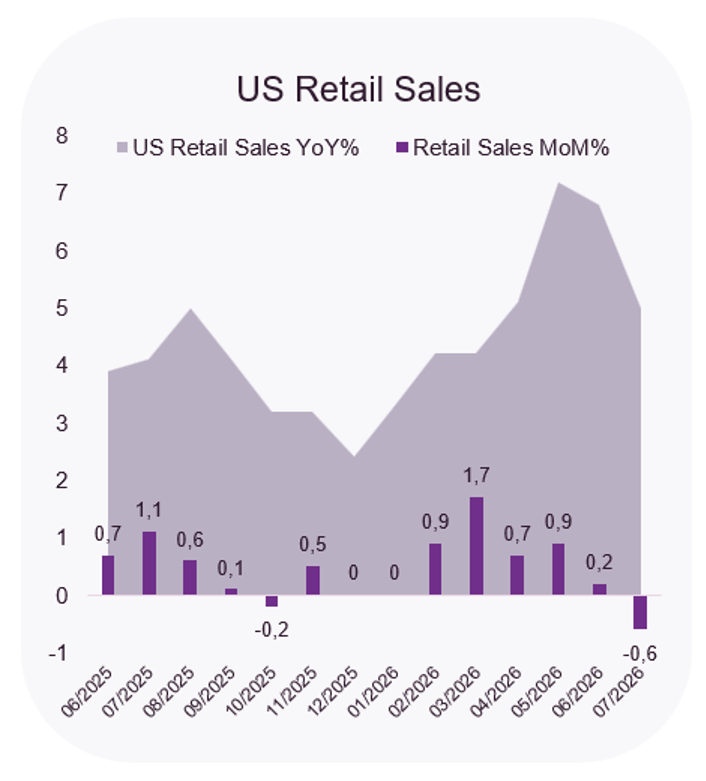
Source: Bloomberg, BIL
Calendar for the week ahead
Monday – Japan GDP Growth (Preliminary, Q2). China House Price Index, Industrial Production, Retail Sales, Unemployment, Fixed Asset Investment (July).
Tuesday – UK Unemployment Rate and Labour Productivity. Eurozone and Germany ZEW Economic Sentiment Index (August). US Housing Starts, Building Permits and Pending Home Sales.
Wednesday – UK Inflation (July). Eurozone Inflation (Final, July). US FOMC Minutes
Thursday – Japan Balance of Trade. China Loan Prime Rate. Eurozone Labour Cost Index (Flash, Q2). US Weekly Jobless Claims
Friday – Japan Inflation (July). UK Gfk Consumer Confidence and Retail Sales. US, Eurozone, UK, Japan Composite PMI (Flash, August). France Business Confidence. Eurozone Consumer Confidence (Flash, August), Negotiated Wage Growth (Q2).
Disclaimer
All financial data and/or economic information released by this Publication (the “Publication”); (the “Data” or the “Financial data
and/or economic information”), are provided for information purposes only,
without warranty of any kind, including without limitation the warranties of merchantability, fitness for a particular
purpose or warranties and non-infringement of any patent, intellectual property or proprietary rights of any party, and
are not intended for trading purposes. Banque Internationale à Luxembourg SA (the “Bank”) does not guarantee expressly or
impliedly, the sequence, accuracy, adequacy, legality, completeness, reliability, usefulness or timeless of any Data.
All Financial data and/or economic information provided may be delayed or may contain errors or be incomplete.
This disclaimer applies to both isolated and aggregate uses of the Data. All Data is provided on an “as is” basis. None of
the Financial data and/or economic information contained on this Publication constitutes a solicitation, offer, opinion, or
recommendation, a guarantee of results, nor a solicitation by the Bank of an offer to buy or sell any security, products and
services mentioned into it or to make investments. Moreover, none of the Financial data and/or economic information contained on
this Publication provides legal, tax accounting, financial or investment advice or services regarding the profitability or
suitability of any security or investment. This Publication has not been prepared with the aim to take an investor’s particular investment objectives,
financial position or needs into account. It is up to the investor himself to consider whether the Data contained herein this
Publication is appropriate to his needs, financial position and objectives or to seek professional independent advice before making
an investment decision based upon the Data. No investment decision whatsoever may result from solely reading this document. In order
to read and understand the Financial data and/or economic information included in this document, you will need to have knowledge and
experience of financial markets. If this is not the case, please contact your relationship manager. This Publication is prepared by
the Bank and is based on data available to the public and upon information from sources believed to be reliable and accurate, taken from
stock exchanges and third parties. The Bank, including its parent,- subsidiary or affiliate entities, agents, directors, officers,
employees, representatives or suppliers, shall not, directly or indirectly, be liable, in any way, for any: inaccuracies or errors
in or omissions from the Financial data and/or economic information, including but not limited to financial data regardless of the
cause of such or for any investment decision made, action taken, or action not taken of whatever nature in reliance upon any Data
provided herein, nor for any loss or damage, direct or indirect, special or consequential, arising from any use of this Publication
or of its content. This Publication is only valid at the moment of its editing, unless otherwise specified. All Financial data and/or
economic information contained herein can also quickly become out-of- date. All Data is subject to change without notice and may not be
incorporated in any new version of this Publication. The Bank has no obligation to update this Publication upon the availability of new data,
the occurrence of new events and/or other evolutions. Before making an investment decision, the investor must read carefully the terms and
conditions of the documentation relating to the specific products or services. Past performance is no guarantee of future performance.
Products or services described in this Publication may not be available in all countries and may be subject to restrictions in some persons
or in some countries. No part of this Publication may be reproduced, distributed, modified, linked to or used for any public or commercial
purpose without the prior written consent of the Bank. In any case, all Financial data and/or economic information provided on this Publication
are not intended for use by, or distribution to, any person or entity in any jurisdiction or country where such use or distribution would be
contrary to law and/or regulation. If you have obtained this Publication from a source other than the Bank website, be aware that electronic
documentation can be altered subsequent to original distribution.
As economic conditions are subject to change, the information and opinions presented in this outlook are current only as of the date
indicated in the matrix or the publication date. This publication is based on data available to the public and upon information that is
considered as reliable. Even if particular attention has been paid to its content, no guarantee, warranty or representation is given to the
accuracy or completeness thereof. Banque Internationale à Luxembourg cannot be held liable or responsible with respect to the information
expressed herein. This document has been prepared only for information purposes and does not constitute an offer or invitation to make investments.
It is up to investors themselves to consider whether the information contained herein is appropriate to their needs and objectives or to seek advice
before making an investment decision based upon this information. Banque Internationale à Luxembourg accepts no liability whatsoever for any investment
decisions of whatever nature by the user of this publication, which are in any way based on this publication, nor for any loss or damage arising
from any use of this publication or its content. This publication, prepared by Banque Internationale à Luxembourg (BIL), may not be copied or
duplicated in any form whatsoever or redistributed without the prior written consent of BIL 69, route d’Esch ı L-2953 Luxembourg ı
RCS Luxembourg B-6307 ı Tel. +352 4590 6699 ı www.bil.com.
Read more