
BIL INVESTMENT INSIGHTS

The oil market was front and centre again last week, after Brent crude crossed the psychological $100 per barrel threshold. The war in the Middle East has persisted for seven months by now, and previous buffers against a supply shock are beginning to wear thin. Strategic reserves are low, fiscal deficits limit how much support governments can offer, and Chinese oil demand is back. All the while, Saudi Arabia reported that its crude oil production dropped to levels unseen since 1990 in August. The transportation of oil and other petroleum products could become even more complicated, with Iran-backed Houthis now having seized the Yemeni Red Sea port of Mocha as they advance south towards the Bab al-Mandeb Strait – a crucial shipping conduit.
Nonetheless, towards the tail-end of the week, after rising towards $109 per barrel, Brent fell to around $104. The move appeared to be the result of revised IEA forecasts, which saw lower oil demand this year than previously expected. This led to brightened sentiment in stock markets, and long-term bond yields retreated from multi-year highs.
Next week will be a big week for monetary policy, with the Fed, the BoE and the BoJ all set to decide on their policy calibrations.
Macro Snapshot
ECB hikes by 25bp to 2.5%
The ECB raised interest rates by 25 basis points to 2.5%. The move was widely expected by markets, so the tone of the accompanying communication - which left the door open to further tightening - took precedence.
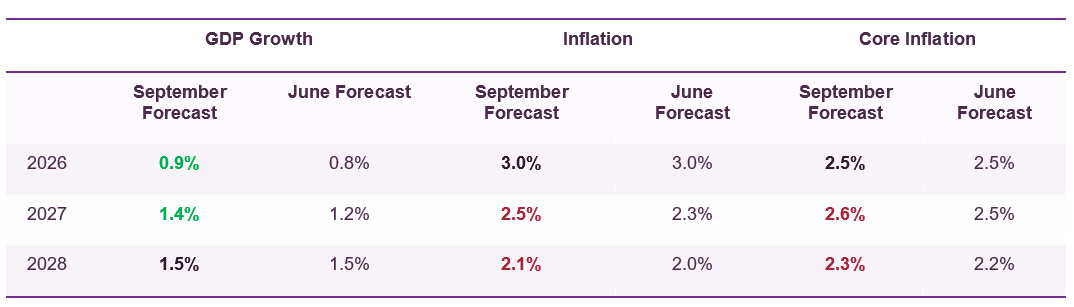
Policymakers revised their inflation projections higher and now expect price growth to remain above the ECB's 2% target throughout the forecast horizon, with it sitting at 2.1% in 2028. The Governing Council also warned that inflation is likely to stay above target for an "extended period". Europe’s energy dependencies leave it vulnerable to higher global prices resulting from the ongoing war in the Middle East. Last week, European natural gas prices hit levels unseen since early 2023.
At the same time, the ECB upgraded its growth outlook after the euro area economy proved more resilient than expected. GDP growth is now forecast at 0.9% in 2026 and 1.4% in 2027, with the ECB citing the stronger-than-anticipated performance of the economy in recent quarters.
The statement also highlighted the elevated uncertainty surrounding the outlook. Notably, the ECB described the situation as "highly uncertain", a stronger formulation than the "uncertain" outlook used in June. It also said that risks are tilted to the upside for inflation and to the downside for economic growth.
Markets interpreted the meeting as distinctly hawkish. Investors continue to expect additional tightening, with money markets fully pricing in another 25bp increase before year-end and a further move by March 2027.
The ECB reiterated that future decisions will remain data-dependent and will be taken on a meeting-by-meeting basis. Meanwhile, the balance sheet continues to shrink gradually, with both the APP and PEPP portfolios declining as maturing securities are no longer being fully reinvested.
Despite the hawkish message and the repricing of rate expectations, the euro failed to gain support following the announcement, suggesting markets had already largely anticipated the more aggressive policy stance.
ECB Staff Projections
Source: ECB, BIL
US core inflation surprises on the upside, boosting rate hike bets
Aspects of Friday’s US inflation report came in stronger than expected, reinforcing market expectations that the Federal Reserve will need to tighten policy further if it is to keep inflation contained.
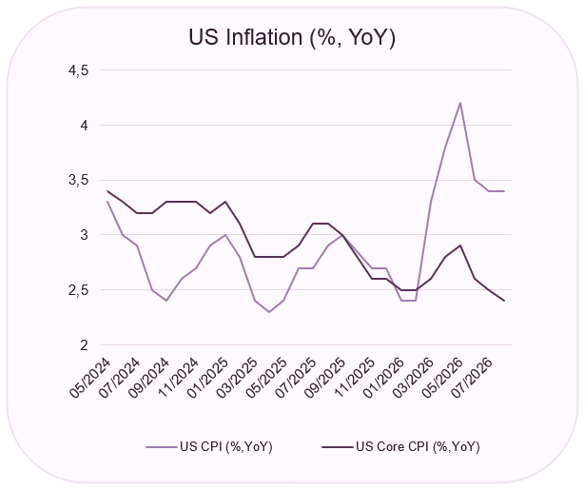
At first glance, the headline inflation print looked benign, remaining unchanged at 3.4% YoY in August. Inflation moderated in some key categories, including shelter, where annual inflation eased to 3.0% from 3.2%, and food, which slowed to 2.7% from 3.0%. However, Energy prices continued to soar, with gasoline prices rising 27.4% from a year earlier and fuel oil prices surging 52%.
Computer software and accessories prices rose a record 25.4% from a year earlier, suggesting that growing demand linked to artificial intelligence may be contributing to inflationary pressures in certain sectors.
On a monthly basis, consumer prices increased by 0.4%, the largest rise in three months, driven largely by a 3.9% increase in gasoline prices, which accounted for more than one-third of the monthly gain. Additional price increases were observed in communication services, airline fares, and used vehicles. The clincher for markets was that core inflation, which excludes food and energy, rose 0.3% month-on-month, accelerating from July's 0.2% pace and highlighting ongoing inflationary pressures. Although annual core inflation edged down to 2.4%, its lowest level since March 2021, markets focused on the stronger monthly reading. Following the print, markets are betting with a high probability that the Fed will hike rates on Wednesday. One more hike later in the year is also viewed as possible, if not plausible.
On the flipside, elevated prices continue to erode consumer sentiment. Also on Friday, the Michigan Consumer Sentiment Index fell to 47.8, well below expectations of 51.0. It was the weakest reading since May’s record low, with optimism around the future state of personal finances deteriorating, as households foresee greater pressure on household budgets amid rising fuel prices and trade tensions. Overall sentiment is now 16% below February levels, before the start of the Iran conflict, and 13% below its level a year ago. Year-ahead inflation expectations jumped to 4.6%, while five-year expectations inched up to 3.4% after coasting at 3.3% for three consecutive months.
Source: Bloomberg, BIL
Copper Hits Record High as Global Demand Accelerates
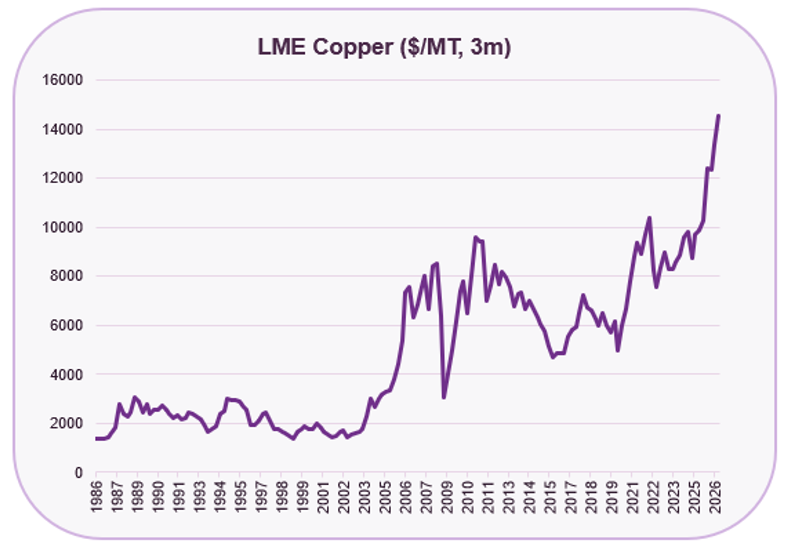
Copper prices surged to a record high above $14,530 per tonne intraday on Tuesday – a fact worth noting given that the pink metal has a reputation for being able to signal shifts in the global economy. Often viewed as a barometer of economic health, copper demand is closely linked to industrial production, construction activity, infrastructure investment, and the energy transition.
It appears that surging investment in electrification, renewable energy, data centers, and AI infrastructure is driving a sharp increase in copper consumption, while tightening supply conditions are adding further upward pressure on prices. The move also points to the risk of renewed inflationary pressures, as higher raw material costs percolate down through supply chains.
Source: Bloomberg, BIL as of 8/9/26. Past performance is not a reliable indicator of future performance
Eurozone GDP growth revised up
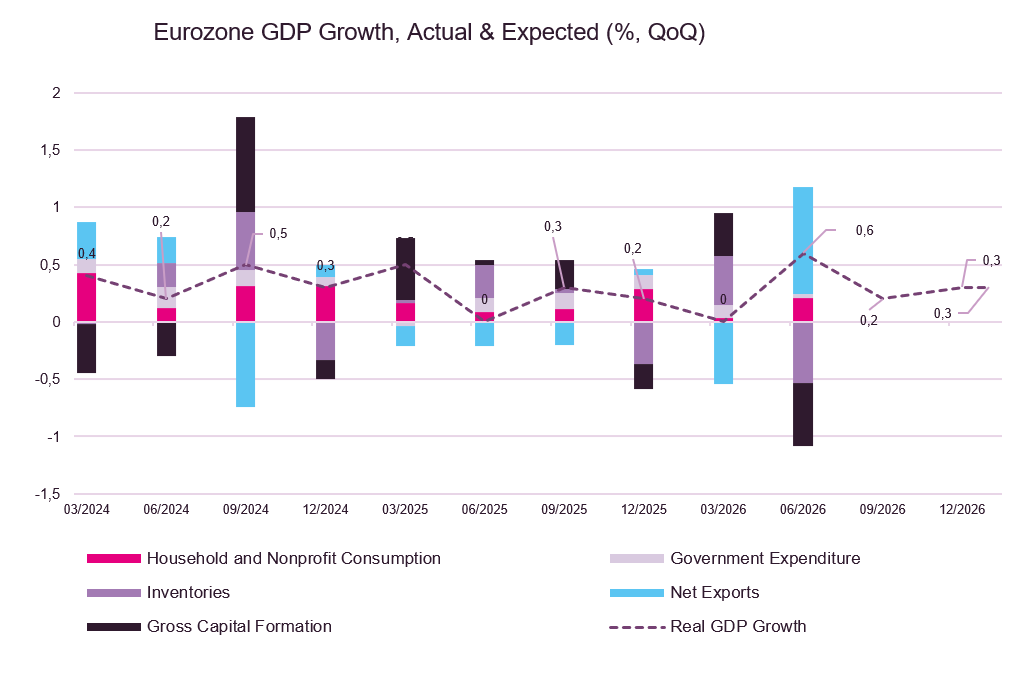
Monday brought the third and final Eurozone GDP estimate for Q2. The economy was shown to have expanded by 0.6%, above the initial estimate of 0.4% and the strongest quarterly growth since Q2 2022. However, a large share of the upward revision reflected Ireland, where GDP rose 10.2% following a 7.8% contraction in Q1. Irish GDP is highly volatile because of the activities of multinational corporations, including profit shifting, transfer pricing, intellectual-property transfers, and other cross-border accounting effects, which can cause large swings in measured output that are not fully representative of underlying domestic economic activity.
Digging into the Eurozone details, net trade was the main driver of growth in Q2, contributing 0.9 percentage points, with exports (+3.4%) comfortably outpacing imports (+1.5%). Changes in inventories acted as a drag, subtracting 0.5p.p, while fixed investment and government consumption made negligible contributions. On an annual basis, GDP growth accelerated to 1.2%, above the previous estimate of 1.0%.
Despite higher energy prices following the conflict in the Middle East and tighter financing conditions, the Eurozone outlook has improved in recent months. Activity is being supported by a stabilization in the manufacturing sector, a gradual recovery in external demand, and increased fiscal spending, particularly in Germany.
While the stronger-than-expected growth figures could embolden ECB hawks, the details of the report provide some reassurance on the inflation front. Employment increased by 0.1% quarter-on-quarter, while compensation per employee slowed to 3.3% from 3.5%, suggesting wage pressures continue to moderate. As a result, the case for an additional ECB rate increase later this year will depend not only on growth data but also on whether higher energy prices begin to feed more persistently into underlying inflation. The evolution of the Middle East crisis will therefore remain a key factor for the policy outlook.
Source: Bloomberg, BIL as of 7/9/26
Calendar for the week ahead
Monday – Japan Industrial Production. China M2 Money Supply
Tuesday – China House Price Index, Industrial Production, Retail Sales, Unemployment, Fixed Asset Investment. UK Unemployment Rate. France and Spain Inflation (Final, August). Eurozone and Germany ZEW Economic Sentiment Index
Wednesday – UK Inflation (CPI and PPI). Italy Inflation (Final, August). Eurozone Industrial Production and Wage Growth. US Retail Sales and Federal Reserve Monetary Policy Decision (with fresh economic projections)
Thursday – Eurozone Inflation (Final, August). Bank of England Monetary Policy Committee. US Housing Starts, Building Permits, Pending Home Sales, Weekly Jobless Claims
Friday – Japan Inflation Rate (August) and Bank of Japan Monetary Policy Decision. Germany PPI. UK Retail Sales. US Industrial Production and Capacity Utilisation.
Disclaimer
All financial data and/or economic information released by this Publication (the “Publication”); (the “Data” or the “Financial data
and/or economic information”), are provided for information purposes only,
without warranty of any kind, including without limitation the warranties of merchantability, fitness for a particular
purpose or warranties and non-infringement of any patent, intellectual property or proprietary rights of any party, and
are not intended for trading purposes. Banque Internationale à Luxembourg SA (the “Bank”) does not guarantee expressly or
impliedly, the sequence, accuracy, adequacy, legality, completeness, reliability, usefulness or timeless of any Data.
All Financial data and/or economic information provided may be delayed or may contain errors or be incomplete.
This disclaimer applies to both isolated and aggregate uses of the Data. All Data is provided on an “as is” basis. None of
the Financial data and/or economic information contained on this Publication constitutes a solicitation, offer, opinion, or
recommendation, a guarantee of results, nor a solicitation by the Bank of an offer to buy or sell any security, products and
services mentioned into it or to make investments. Moreover, none of the Financial data and/or economic information contained on
this Publication provides legal, tax accounting, financial or investment advice or services regarding the profitability or
suitability of any security or investment. This Publication has not been prepared with the aim to take an investor’s particular investment objectives,
financial position or needs into account. It is up to the investor himself to consider whether the Data contained herein this
Publication is appropriate to his needs, financial position and objectives or to seek professional independent advice before making
an investment decision based upon the Data. No investment decision whatsoever may result from solely reading this document. In order
to read and understand the Financial data and/or economic information included in this document, you will need to have knowledge and
experience of financial markets. If this is not the case, please contact your relationship manager. This Publication is prepared by
the Bank and is based on data available to the public and upon information from sources believed to be reliable and accurate, taken from
stock exchanges and third parties. The Bank, including its parent,- subsidiary or affiliate entities, agents, directors, officers,
employees, representatives or suppliers, shall not, directly or indirectly, be liable, in any way, for any: inaccuracies or errors
in or omissions from the Financial data and/or economic information, including but not limited to financial data regardless of the
cause of such or for any investment decision made, action taken, or action not taken of whatever nature in reliance upon any Data
provided herein, nor for any loss or damage, direct or indirect, special or consequential, arising from any use of this Publication
or of its content. This Publication is only valid at the moment of its editing, unless otherwise specified. All Financial data and/or
economic information contained herein can also quickly become out-of- date. All Data is subject to change without notice and may not be
incorporated in any new version of this Publication. The Bank has no obligation to update this Publication upon the availability of new data,
the occurrence of new events and/or other evolutions. Before making an investment decision, the investor must read carefully the terms and
conditions of the documentation relating to the specific products or services. Past performance is no guarantee of future performance.
Products or services described in this Publication may not be available in all countries and may be subject to restrictions in some persons
or in some countries. No part of this Publication may be reproduced, distributed, modified, linked to or used for any public or commercial
purpose without the prior written consent of the Bank. In any case, all Financial data and/or economic information provided on this Publication
are not intended for use by, or distribution to, any person or entity in any jurisdiction or country where such use or distribution would be
contrary to law and/or regulation. If you have obtained this Publication from a source other than the Bank website, be aware that electronic
documentation can be altered subsequent to original distribution.
As economic conditions are subject to change, the information and opinions presented in this outlook are current only as of the date
indicated in the matrix or the publication date. This publication is based on data available to the public and upon information that is
considered as reliable. Even if particular attention has been paid to its content, no guarantee, warranty or representation is given to the
accuracy or completeness thereof. Banque Internationale à Luxembourg cannot be held liable or responsible with respect to the information
expressed herein. This document has been prepared only for information purposes and does not constitute an offer or invitation to make investments.
It is up to investors themselves to consider whether the information contained herein is appropriate to their needs and objectives or to seek advice
before making an investment decision based upon this information. Banque Internationale à Luxembourg accepts no liability whatsoever for any investment
decisions of whatever nature by the user of this publication, which are in any way based on this publication, nor for any loss or damage arising
from any use of this publication or its content. This publication, prepared by Banque Internationale à Luxembourg (BIL), may not be copied or
duplicated in any form whatsoever or redistributed without the prior written consent of BIL 69, route d’Esch ı L-2953 Luxembourg ı
RCS Luxembourg B-6307 ı Tel. +352 4590 6699 ı www.bil.com.
Read more
More
September 21, 2026
Weekly Investment Insights
Equities came under pressure at the beginning of last week after leading voices in the AI industry called for a slower pace of technological...
September 7, 2026
Weekly InsightsWeekly Investment Insights
At the onset of last week, the sell-off in global bonds intensified. UK borrowing costs hit their highest level since 2008, while Japan's rose...
August 31, 2026
Weekly InsightsWeekly Investment Insights
Strong earnings from a leading AI company lifted tech firms, and helped both the Nasdaq and the S&P 500 close the week higher, but smaller-cap...
August 24, 2026
Weekly InsightsWeekly Investment Insights
US gross national debt has climbed above $40 trillion, underscoring the growing fiscal challenges facing the world's largest economy. The increase reflects years of persistent...
August 17, 2026
Weekly InsightsWeekly Investment Insights
US Treasury markets were in focus last week as investors demanded higher compensation to absorb growing government borrowing needs. A $42 billion auction of...