
BIL INVESTMENT INSIGHTS

Global bond markets have come under pressure in recent months, pushing long-term yields sharply higher. The US 10-year Treasury yield, potentially one of the most critical numbers in global finance given its widespread use as a benchmark, has touched 5.35%, its highest level since 2002. In Europe, government bond markets have become increasingly fragmented, with countries carrying weaker fiscal profiles - particularly France - facing a more pronounced rise in borrowing costs.
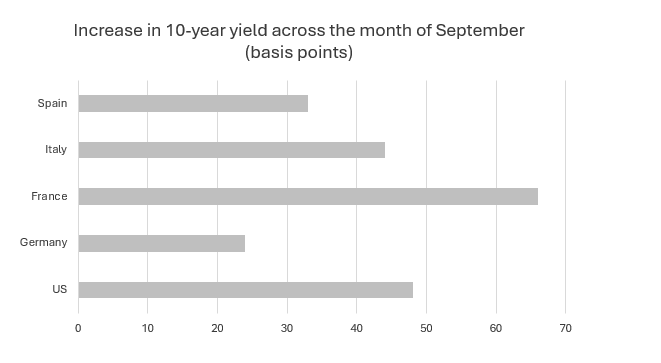
Source: Bloomberg, BIL
Markets are currently trying to determine where long-term interest rates should settle in a world characterised by higher borrowing needs among corporates and countries, resilient growth, and greater inflation uncertainty. In aviation terms, bond markets are still climbing and have yet to find a clear cruising altitude. Further turbulence could ensue.
Why are long-term yields moving higher?
Several factors continue to exert upward pressure on yields.
First, governments continue to run large budget deficits. Global public debt hit 94% of world GDP last year, up more than 10 percentage points from pre-pandemic levels. The IMF now believes it will reach 100% by the end of this decade, with government financing needs showing very few signs of slowing. Reasons for this include needs to fund defense in an increasingly volatile world, to upgrade energy infrastructure, or to service existing debt. Regarding the latter, it is estimated that 78% of borrowing by OECD governments in 2026 will go to refinancing existing debt. In light of this, investors are increasingly demanding additional compensation to absorb the growing supply of sovereign debt entering the market.
Second, corporate borrowing demand remains exceptionally strong. The AI investment cycle is driving one of the largest capital expenditure booms in recent history. Until now, a lot of the spending has been financed by the hyperscalers’ large cash piles. That is changing, and now more are tapping the bond market. The OECD expects that corporate bond issuance by nine major AI players will hit USD 1.2 trillion between now and 2030. A flow of new bonds – often with solid fundamentals - intensifies competition for capital and adds further pressure to bond markets.
Third, inflation uncertainty has resurfaced. Hostilities in the Middle East continue to stoke energy supply worries, with Brent trading above $100/ barrel. The reality is that even if oil prices eventually stabilise at lower levels, higher energy costs could continue feeding through to other categories such as utility bills, wages, services and food costs, with a lag. As a result, central banks can no longer look through the supply shock and have been forced to adopt a more hawkish stance.
Fourth, economic growth has proven more resilient than expected. Business activity indicators continue to point to resilient private sector activity. While stronger growth is generally positive for corporate earnings, it also reduces the urgency for central banks to ease policy and supports higher real interest rates.
Finally, policy normalisation in Japan has removed an important source of global liquidity. For years, Japanese investors helped anchor global bond markets through large overseas purchases. As yields in Japan have become more attractive, some of that capital has begun to return home.
What would allow yields to stabilise?
Although yields have already risen significantly, for them to reach some sort of equilibrium, we would need to see a combination of things happen.
The most important requirement would be credible fiscal consolidation. Investors need confidence that governments are willing and able to place public finances on a more sustainable path over the medium term. At present, political constraints make meaningful deficit reduction difficult in many developed economies, suggesting that fiscal concerns are likely to remain a feature of markets. In France, for example, attempts at consolidation have been met with violent nationwide protests.
A second requirement would be a moderation in borrowing demand. The AI investment cycle and extensive government financing programmes have created a large supply of new bonds. Over time, higher financing costs should naturally dampen issuance, but there is little evidence of that dynamic emerging yet.
Third, investors would need greater confidence that inflation risks are contained. A stabilisation in energy prices, or a reduction in geopolitical tensions would help ensure long-term inflation expectations stay anchored.
Absent these developments, long-term yields may continue searching for their equilibrium level in the months ahead.
Investment Strategy
Against this backdrop, we continue to favour equities over bonds.
Equity markets have shown remarkable resilience despite rising yields and elevated geopolitical uncertainty. The main explanation remains earnings growth. Companies continue to generate strong profitability, while the AI investment cycle is creating powerful growth opportunities across technology, infrastructure and industrial value chains. Although valuations are no longer cheap, earnings momentum remains supportive: expected earnings-per-share growth in the US is 28.5% this year, and 17.3% in Europe.
Within equities, we continue to favour the United States. We do not want to be on the sidelines of the AI revolution, but our focus is evolving. More concretely, we are growing more cautious on the “picks and shovels” of AI but we continue to like hyper-scalers. We increasingly see opportunities among companies that can use AI to improve productivity, expand margins and strengthen competitive positioning. The long-term winners may not necessarily be the developers of AI models themselves or those with the best models, but the businesses that can successfully integrate these technologies across large existing customer bases.
At our latest investment committee, we also increased exposure to value-oriented sectors in the US. Historically, periods of higher interest rates and rising bond yields have favoured value stocks, whose earnings tend to be generated over shorter time horizons and are therefore less sensitive to changes in discount rates.
Within fixed income, we remain cautious on duration, given that rates could move even higher amid heavy bond issuance. We took additional measures to reduce exposure to French government sovereigns, as fiscal challenges, political uncertainty and rising borrowing costs continue to create an unfavourable risk-reward profile. Note that we have also been actively reviewing our French equity exposure too, and adjusting where necessary.
Investment grade corporate bonds remain the cornerstone of our fixed-income allocation. Corporate fundamentals remain healthy, balance sheets are generally robust and current yields continue to offer attractive income opportunities. Selectivity is the name of the game when it comes to high-yield: nice income opportunities persist, but moving up the quality curve is prudent. In the US, for example, we see stress gathering among the lowest rated issuers, and the risk premium for companies rated triple C or lower has risen to levels unseen since 2022.
In summary, while long-term yields have already climbed significantly, we believe the market has yet to reach a stable cruising altitude. Until fiscal, inflation and issuance dynamics look more encouraging, upward pressure on long-term rates is likely to persist. In that environment, we continue to favour equities, maintain a cautious stance on duration, and focus on high-quality corporate credit.

Disclaimer
All financial data and/or economic information released by this Publication (the “Publication”); (the “Data” or the “Financial data
and/or economic information”), are provided for information purposes only,
without warranty of any kind, including without limitation the warranties of merchantability, fitness for a particular
purpose or warranties and non-infringement of any patent, intellectual property or proprietary rights of any party, and
are not intended for trading purposes. Banque Internationale à Luxembourg SA (the “Bank”) does not guarantee expressly or
impliedly, the sequence, accuracy, adequacy, legality, completeness, reliability, usefulness or timeless of any Data.
All Financial data and/or economic information provided may be delayed or may contain errors or be incomplete.
This disclaimer applies to both isolated and aggregate uses of the Data. All Data is provided on an “as is” basis. None of
the Financial data and/or economic information contained on this Publication constitutes a solicitation, offer, opinion, or
recommendation, a guarantee of results, nor a solicitation by the Bank of an offer to buy or sell any security, products and
services mentioned into it or to make investments. Moreover, none of the Financial data and/or economic information contained on
this Publication provides legal, tax accounting, financial or investment advice or services regarding the profitability or
suitability of any security or investment. This Publication has not been prepared with the aim to take an investor’s particular investment objectives,
financial position or needs into account. It is up to the investor himself to consider whether the Data contained herein this
Publication is appropriate to his needs, financial position and objectives or to seek professional independent advice before making
an investment decision based upon the Data. No investment decision whatsoever may result from solely reading this document. In order
to read and understand the Financial data and/or economic information included in this document, you will need to have knowledge and
experience of financial markets. If this is not the case, please contact your relationship manager. This Publication is prepared by
the Bank and is based on data available to the public and upon information from sources believed to be reliable and accurate, taken from
stock exchanges and third parties. The Bank, including its parent,- subsidiary or affiliate entities, agents, directors, officers,
employees, representatives or suppliers, shall not, directly or indirectly, be liable, in any way, for any: inaccuracies or errors
in or omissions from the Financial data and/or economic information, including but not limited to financial data regardless of the
cause of such or for any investment decision made, action taken, or action not taken of whatever nature in reliance upon any Data
provided herein, nor for any loss or damage, direct or indirect, special or consequential, arising from any use of this Publication
or of its content. This Publication is only valid at the moment of its editing, unless otherwise specified. All Financial data and/or
economic information contained herein can also quickly become out-of- date. All Data is subject to change without notice and may not be
incorporated in any new version of this Publication. The Bank has no obligation to update this Publication upon the availability of new data,
the occurrence of new events and/or other evolutions. Before making an investment decision, the investor must read carefully the terms and
conditions of the documentation relating to the specific products or services. Past performance is no guarantee of future performance.
Products or services described in this Publication may not be available in all countries and may be subject to restrictions in some persons
or in some countries. No part of this Publication may be reproduced, distributed, modified, linked to or used for any public or commercial
purpose without the prior written consent of the Bank. In any case, all Financial data and/or economic information provided on this Publication
are not intended for use by, or distribution to, any person or entity in any jurisdiction or country where such use or distribution would be
contrary to law and/or regulation. If you have obtained this Publication from a source other than the Bank website, be aware that electronic
documentation can be altered subsequent to original distribution.
As economic conditions are subject to change, the information and opinions presented in this outlook are current only as of the date
indicated in the matrix or the publication date. This publication is based on data available to the public and upon information that is
considered as reliable. Even if particular attention has been paid to its content, no guarantee, warranty or representation is given to the
accuracy or completeness thereof. Banque Internationale à Luxembourg cannot be held liable or responsible with respect to the information
expressed herein. This document has been prepared only for information purposes and does not constitute an offer or invitation to make investments.
It is up to investors themselves to consider whether the information contained herein is appropriate to their needs and objectives or to seek advice
before making an investment decision based upon this information. Banque Internationale à Luxembourg accepts no liability whatsoever for any investment
decisions of whatever nature by the user of this publication, which are in any way based on this publication, nor for any loss or damage arising
from any use of this publication or its content. This publication, prepared by Banque Internationale à Luxembourg (BIL), may not be copied or
duplicated in any form whatsoever or redistributed without the prior written consent of BIL 69, route d’Esch ı L-2953 Luxembourg ı
RCS Luxembourg B-6307 ı Tel. +352 4590 6699 ı www.bil.com.
Read more
More
October 6, 2026
NewsEurozone Inflation… energy impa...
The Eurozone has so far weathered the energy shock surprisingly well. Yet beneath the surface, rising fuel costs, weaker fiscal support and resilient growth suggest...
October 2, 2026
Weekly Investment Insights
Posted as of midday 2nd October. Thank you for your continued readership. Please note that our weekly insights will pause throughout October, resuming 2nd...
September 28, 2026
Weekly InsightsWeekly Investment Insights
After a volatile week in which stronger-than-expected PMI data fuelled concerns over persistent inflation and higher interest rates, US equities still managed to finish in...
September 21, 2026
Weekly InsightsWeekly Investment Insights
Equities came under pressure at the beginning of last week after leading voices in the AI industry called for a slower pace of technological...
September 11, 2026
Weekly InsightsWeekly Investment Insights
The oil market was front and centre again last week, after Brent crude crossed the psychological $100 per barrel threshold. The war in the Middle...