
BIL INVESTMENT INSIGHTS

The Eurozone has so far weathered the energy shock surprisingly well. Yet beneath the surface, rising fuel costs, weaker fiscal support and resilient growth suggest the ECB's inflation battle is far from over.
Despite the ongoing energy supply shock, inflation hasn’t been majorly problematic in the Eurozone so far this year. Inflation expectations, as measured by market break-evens, have remained relatively contained and investors initially treated the Middle East energy shock as a temporary event. However, the inflation backdrop is becoming increasingly challenging. A combination of higher energy prices, fading fiscal support, rising food prices and resilient economic activity suggests inflation could remain sticky above the ECB's target for longer than many anticipate.
The starting point is energy. The effective closure of the Strait of Hormuz following the Iran conflict triggered a sharp rise in oil and gas prices. While investors initially expected energy prices to normalize quickly, fading hopes for a diplomatic breakthrough have pushed oil prices higher once again, with Brent currently trading around $105 per barrel. The key concern is not only the level of prices today, but the growing recognition that oil may not return to pre-Iran war levels any time soon. Natural gas prices have risen even more sharply, and unlike oil, the impact on households and businesses typically appears with a significant lag as wholesale prices gradually percolate into utility bills. As a result, the full inflationary impact of the energy shock is likely still ahead of us rather than behind us.
A crucial difference versus the 2022-23 energy crisis is the limited fiscal response given already-elevated core deficits. At the height of the 2022 energy crisis, total EU energy subsidies reached €457 billion. By contrast, in May, the European Commission estimated that the budgetary cost of measures announced in response to the Middle East energy shock amounted to €14.5 billion, rising to €38.6 billion if all measures were extended through the end of 2026. Today, these estimates have proven quite conservative, but absolute spending relative to 2022-23 is still much more modest.
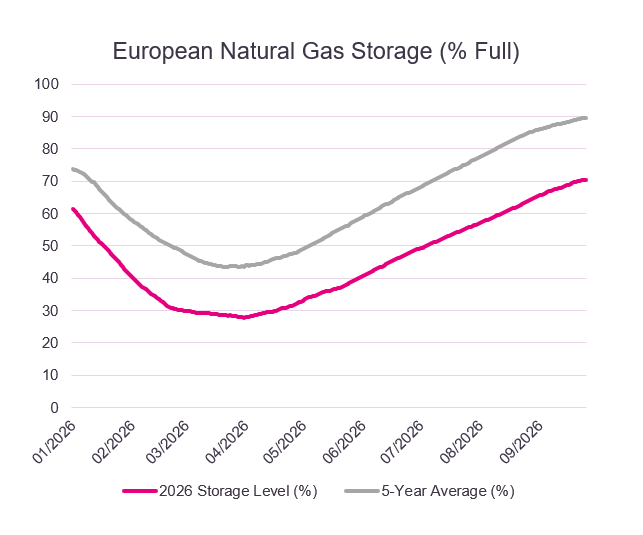
A thinned-down fiscal cushion comes at an inopportune moment. Europe must continue replenishing energy inventories while commodity prices remain elevated. Notably, underground gas storage facilities across the EU are only around 71% full, the lowest level recorded for this time of year since data collection began in 2011. Rebuilding inventories at elevated prices could place additional upward pressure on energy costs heading into winter, increasing the risk that headline inflation remains stubbornly high well into 2027.
Source: Bloomberg, BIL
Inflation risks are also extending beyond energy. Food prices have already experienced a substantial increase in recent years, and further upward pressure is emerging. The Iran war has lifted energy and fertiliser costs, while adverse weather conditions linked to El Niño are creating additional pressure on agricultural production. The combination of higher fertiliser, transport and energy costs is likely to feed through into food prices over the coming quarters.
Encouragingly, there is still not a strong case to suggest that these shocks have generated significant second-round effects. ECB President Christine Lagarde has repeatedly stated that the central bank does not yet see convincing evidence that energy prices are feeding into higher wages across the economy.
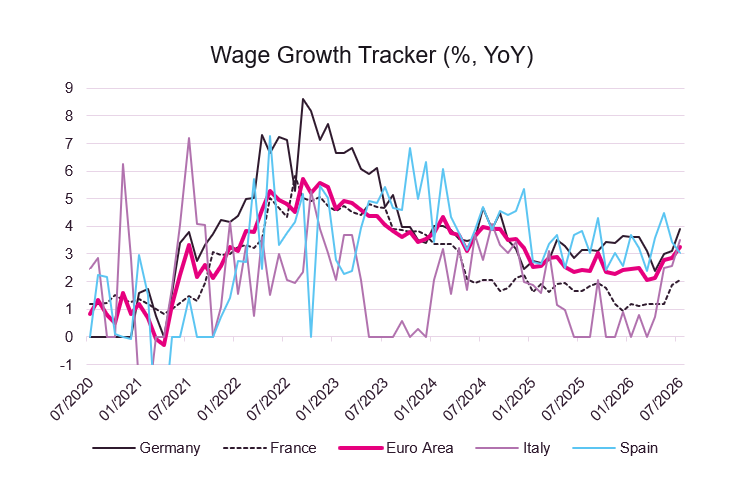
However, it is our view that the risk of a broadening out in inflation pressures should not be dismissed. As the chart shows, wages are already beginning to creep up in the bloc’s largest economies.
Source: Bloomberg, BIL
The risk is that a prolonged period of above-target inflation ultimately influences wage negotiations, particularly given that labour markets remain relatively resilient across much of the Eurozone.
Recent economic data offer little comfort on the inflation front. Survey evidence suggests that Eurozone activity continues to hold up relatively well despite higher commodity prices. The composite PMI remains consistent with ongoing expansion and points to accelerating price pressures. According to the latest flash readings, both input costs and output prices increased in September at the fastest pace in four months. This resilience is important because it reduces the likelihood that weaker demand will naturally bring inflation back towards target. Instead, it raises the possibility that the ECB will need to maintain a restrictive policy stance for longer.
Financial markets appear to be moving in that direction. Investors are already pricing almost four additional quarter-point ECB rate increases over the next year, on top of the two hikes already delivered.
Our base case is that inflation remains above the ECB's 2% target throughout 2027. Higher oil prices should keep headline inflation elevated through year-end, while the delayed pass-through of higher natural gas prices is likely to sustain pressure on household utility bills. We expect the ECB to raise the deposit rate once more in December to 2.75%, which would take policy deeper into restrictive territory. Beyond that, the duration the energy crisis - and its ripple effects – will largely determine the policy pathway.
But overall, Eurozone inflation risks are skewed to the upside. Energy prices are higher, fiscal support is constrained, soft commodity prices are on the up, and economic activity remains surprisingly resilient. While inflation may not yet be embedded in wages and inflation expectations, the ECB's fight against inflation is not over. Markets appear to recognise this, but there is a growing risk that participants are still underestimating how persistent the current inflation shock could become.
Disclaimer
All financial data and/or economic information released by this Publication (the “Publication”); (the “Data” or the “Financial data
and/or economic information”), are provided for information purposes only,
without warranty of any kind, including without limitation the warranties of merchantability, fitness for a particular
purpose or warranties and non-infringement of any patent, intellectual property or proprietary rights of any party, and
are not intended for trading purposes. Banque Internationale à Luxembourg SA (the “Bank”) does not guarantee expressly or
impliedly, the sequence, accuracy, adequacy, legality, completeness, reliability, usefulness or timeless of any Data.
All Financial data and/or economic information provided may be delayed or may contain errors or be incomplete.
This disclaimer applies to both isolated and aggregate uses of the Data. All Data is provided on an “as is” basis. None of
the Financial data and/or economic information contained on this Publication constitutes a solicitation, offer, opinion, or
recommendation, a guarantee of results, nor a solicitation by the Bank of an offer to buy or sell any security, products and
services mentioned into it or to make investments. Moreover, none of the Financial data and/or economic information contained on
this Publication provides legal, tax accounting, financial or investment advice or services regarding the profitability or
suitability of any security or investment. This Publication has not been prepared with the aim to take an investor’s particular investment objectives,
financial position or needs into account. It is up to the investor himself to consider whether the Data contained herein this
Publication is appropriate to his needs, financial position and objectives or to seek professional independent advice before making
an investment decision based upon the Data. No investment decision whatsoever may result from solely reading this document. In order
to read and understand the Financial data and/or economic information included in this document, you will need to have knowledge and
experience of financial markets. If this is not the case, please contact your relationship manager. This Publication is prepared by
the Bank and is based on data available to the public and upon information from sources believed to be reliable and accurate, taken from
stock exchanges and third parties. The Bank, including its parent,- subsidiary or affiliate entities, agents, directors, officers,
employees, representatives or suppliers, shall not, directly or indirectly, be liable, in any way, for any: inaccuracies or errors
in or omissions from the Financial data and/or economic information, including but not limited to financial data regardless of the
cause of such or for any investment decision made, action taken, or action not taken of whatever nature in reliance upon any Data
provided herein, nor for any loss or damage, direct or indirect, special or consequential, arising from any use of this Publication
or of its content. This Publication is only valid at the moment of its editing, unless otherwise specified. All Financial data and/or
economic information contained herein can also quickly become out-of- date. All Data is subject to change without notice and may not be
incorporated in any new version of this Publication. The Bank has no obligation to update this Publication upon the availability of new data,
the occurrence of new events and/or other evolutions. Before making an investment decision, the investor must read carefully the terms and
conditions of the documentation relating to the specific products or services. Past performance is no guarantee of future performance.
Products or services described in this Publication may not be available in all countries and may be subject to restrictions in some persons
or in some countries. No part of this Publication may be reproduced, distributed, modified, linked to or used for any public or commercial
purpose without the prior written consent of the Bank. In any case, all Financial data and/or economic information provided on this Publication
are not intended for use by, or distribution to, any person or entity in any jurisdiction or country where such use or distribution would be
contrary to law and/or regulation. If you have obtained this Publication from a source other than the Bank website, be aware that electronic
documentation can be altered subsequent to original distribution.
As economic conditions are subject to change, the information and opinions presented in this outlook are current only as of the date
indicated in the matrix or the publication date. This publication is based on data available to the public and upon information that is
considered as reliable. Even if particular attention has been paid to its content, no guarantee, warranty or representation is given to the
accuracy or completeness thereof. Banque Internationale à Luxembourg cannot be held liable or responsible with respect to the information
expressed herein. This document has been prepared only for information purposes and does not constitute an offer or invitation to make investments.
It is up to investors themselves to consider whether the information contained herein is appropriate to their needs and objectives or to seek advice
before making an investment decision based upon this information. Banque Internationale à Luxembourg accepts no liability whatsoever for any investment
decisions of whatever nature by the user of this publication, which are in any way based on this publication, nor for any loss or damage arising
from any use of this publication or its content. This publication, prepared by Banque Internationale à Luxembourg (BIL), may not be copied or
duplicated in any form whatsoever or redistributed without the prior written consent of BIL 69, route d’Esch ı L-2953 Luxembourg ı
RCS Luxembourg B-6307 ı Tel. +352 4590 6699 ı www.bil.com.
Read more
More
October 8, 2026
BILBoardBIL Board October 2026 – Long-T...
Global bond markets have come under pressure in recent months, pushing long-term yields sharply higher. The US 10-year Treasury yield, potentially one of the most...
October 2, 2026
Weekly Investment Insights
Posted as of midday 2nd October. Thank you for your continued readership. Please note that our weekly insights will pause throughout October, resuming 2nd...
September 28, 2026
Weekly InsightsWeekly Investment Insights
After a volatile week in which stronger-than-expected PMI data fuelled concerns over persistent inflation and higher interest rates, US equities still managed to finish in...
September 21, 2026
Weekly InsightsWeekly Investment Insights
Equities came under pressure at the beginning of last week after leading voices in the AI industry called for a slower pace of technological...
September 11, 2026
Weekly InsightsWeekly Investment Insights
The oil market was front and centre again last week, after Brent crude crossed the psychological $100 per barrel threshold. The war in the Middle...