
BIL INVESTMENT INSIGHTS

Sunday, 21 June marks the official start of summer here in the northern hemisphere. Yet, after an unseasonably warm spring, conditions have turned cooler and more unsettled. The question now is whether the early heat was the peak, or if a long, hot summer still lies ahead.
A similar dynamic has played out in financial markets. Risk assets have delivered a strong first half, reaching successive highs despite geopolitical tensions, renewed trade frictions, and an energy shock stemming from the war in Middle East. So far, robust corporate earnings and the strength of the AI investment cycle have offset these headwinds.
After such robust performance, the outlook has now become less clear. Markets now face a more delicate balance between powerful structural support and cyclical risks.
In this midyear update, we revisit our base case for 2026, assess how it has evolved in light of recent developments, and outline our expectations for the second half of the year.
Macroeconomic Outlook
At the start of the year, we anticipated a relatively subdued macroeconomic environment, with global growth of around 3%, broadly in line with its long‑term average. Since then, our core view has shifted slightly. We now expect global growth to come in modestly below trend. Activity continues to expand, but at a measured pace, with little evidence of a meaningful reacceleration. At the same time, regional divergence has become more pronounced, and geopolitics remain a key wild card; unpredictable by nature, but an essential factor to monitor and adapt to as conditions evolve.
United States: Running hot
Our initial expectation of steady growth, underpinned by strong investment in AI and fiscal support, has largely materialised. Manufacturing activity is picking up, corporate earnings remain solid, and energy independence is a game changer, with crude exports reaching record highs.
The US consumer has shown remarkable resilience. An “E-shaped” consumption pattern emerged, momentarily interrupting talk of a “K-shaped economy”, with spending holding up across income groups. Whether this continues depends largely on the labour market, and encouragingly, recent developments suggest stabilisation therein, which could help sustain consumption.
Inflation remains a key risk. At the start of the year, we anticipated that it would remain sticky in the first half, primarily due to the lagged effects of tariffs. This has proven correct, though developments in energy markets have amplified the effect. Inflation is now running too hot at 4.2% YoY. Beyond energy, the AI rollout is also causing prices to heat up. For example, a surge in demand for memory chips - crucial for data centres but also for personal computers and tablets – is making them more expensive.
As a result, monetary policy expectations have shifted significantly. Anticipated Fed rate cuts have been kicked into 2027, and the possibility of a rate hike this year has entered the discussion.
Eurozone: Darkening skies
We entered the year with a more cautious stance on the Eurozone than a lot of peers, and this has proven justified - conditions have been weaker than anticipated.
Simultaneously, our initial expectation that inflation would remain around, or even below, the ECB’s target has been overturned. Rising energy costs mean inflation has been above target for three months running and, after June’s quarter-point increase, markets are pricing in two more rate hikes in 2026.
The bloc’s economic slowdown is most evident in core economies such as Germany, where industrial weakness persists. Meanwhile, widely anticipated fiscal stimulus is not yet translating into meaningful economic activity. Spain remains a relative bright spot, supported by stronger productivity and fiscal dynamics.
China: A microclimate
China continues to follow a distinct trajectory, one that is less about short-term results, more about long-term positioning. Our base case remains largely unchanged. Strategically important sectors, particularly AI and advanced manufacturing, have strong forward momentum, supported by policy backing. However, weak domestic demand and ongoing property sector fragility continue to weigh on consumption and broader investment.
Japan: Exiting the deflationary winter
Japan has been quietly exceeding expectations. Inflation has remained above target for the best part of two years, while rising wages are beginning to support a gradual recovery in domestic consumption.
At the same time, Japanese companies are increasingly relevant to the global AI theme - not as headline players, but as critical enablers. Strengths in semiconductor equipment and advanced packaging, robotics, fibre-optic cabling for data centres, and high-quality materials, position Japan well to benefit from sustained technological investment.
Emerging Markets: Riding tailwinds
Emerging markets have continued to benefit from a weaker US dollar, alongside a range of more idiosyncratic growth drivers. In Asia, select economies are basking in direct exposure to the global AI investment cycle. While several countries in LatAm continue to run current account deficits, these remain manageable and are partly offset by strong commodity export revenues, providing a degree of resilience amid global uncertainty.
Global energy markets
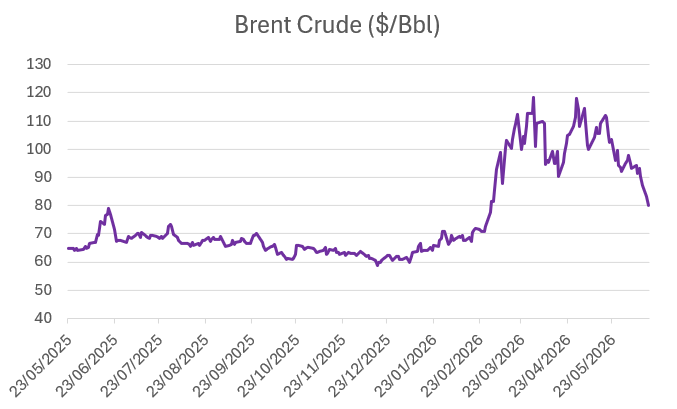
The geopolitical backdrop remains one of the defining features of 2026. Tensions in the Middle East persist, and it is yet to be seen whether an interim deal between the US and Iran will hold, especially as more difficult conversations around Iran’s nuclear program begin. Even if the Strait of Hormuz reopens as planned on June 19, it will take time for energy flows to normalize, especially considering the damage to critical energy infrastructure across the region.
Encouragingly, global energy markets have started to adjust. Alternative producers, most notably the US and Venezuela, are increasing output, while investment is being redirected toward new sources of supply, including Argentina’s vast shale reserves.
In the near term, however, we would expect supply constraints continue feeding into higher energy prices and inflationary pressures. The key question is whether these pressures become entrenched or prove transitory. Markets are leaning toward the latter.
Source: Bloomberg, BIL as of 16 June
Investment Strategy
Equities: Narrow leadership
We continue to see opportunities across equity markets, maintaining an overall bias toward the US.
In the US, the Q1 2026 earnings season was particularly strong, marking the most robust performance since the post-pandemic rebound. S&P 500 earnings per share (EPS) grew by approximately 29% year-on-year on a blended basis, or around 15% excluding AI-related companies, while revenues rose by 11.6%.
This strong performance has led to meaningful upward revisions to forward expectations. Consensus now forecasts US EPS growth of 21.7% and revenue growth of 10.5% over the next three quarters. The key risk remains earnings concentration. Any slowdown in hyperscaler investment or rotation away from mega-cap technology could have an outsized impact on index-level performance. Against this backdrop, we have hedged a portion of our US equity exposure on the downside. Sector-wise, we maintain a preference for IT hardware, as well as AI-adjacent sectors such as utilities and industrials, which continue to benefit from the broader investment cycle. Industrials and firms with real assets are better insulated from technological disruptions, and many looked poised to use AI to become more efficient and even more dominant.
In China, large segments of the market (particularly banks, real estate, and traditional industrials) face structural headwinds, including weak domestic demand and debt overhang. As such, we are focusing exposure on technology and AI-related sectors, which benefit from powerful megatrends like digitalisation and automation, as well as clear policy support from Beijing.
In Japan, we focus on large, export-oriented companies. Industrials, electronics, and semiconductor players are well positioned to benefit from the global AI investment cycle and continued strength in external demand.
We are reluctant on European equities. While earnings growth has improved, reaching over 7% year-on-year in Q1, the recovery remains uneven. Energy has been the primary driver, and excluding this sector, overall EPS growth is essentially flat. More broadly, around 45% of companies have seen earnings downgrades for 2026, highlighting the fragility of the recovery. Much of this lies in the fact that elevated oil prices pose a greater challenge for Europe than for the US, given higher energy intensity and weaker pricing power. Already, margin pressure is creeping in with PMIs suggesting that businesses are struggling to pass on higher costs.
Fixed Income: Cautious on Govies, Selective on Credit
We remain very light on sovereign bonds. The energy shock quickly translated into higher yields across the curve and oil prices continue to exhibit a correlation with rate expectations, influencing both the short and long ends. At the long end, fiscal concerns add further pressure on yields.
Within credit, our approach remains selective. Emerging market debt (EMD) has performed well throughout recent volatility, supported by a weaker dollar and improving growth dynamics. The spread widening observed at the onset of the US-Iran conflict has largely reversed - even among Middle Eastern issuers most directly exposed. Regional divergence, however, remains significant. Latin American countries continue to benefit from their status as commodity exporters, with spreads generally now tighter than pre-conflict levels and momentum remaining positive.
Investment grade credit continues to represent the lion’s share our fixed income allocation. As with EMD, spreads have largely retraced the widening seen earlier in the year, while corporate fundamentals remain broadly solid. While the scope for further spread compression appears limited, all-in yields remain attractive, and elevated break-even levels provide a cushion against further moves in either rates or spreads. Supply has been heavy year-to-date, driven by front-loaded issuance, particularly from hyperscalers and financials, which should translate into more favourable technical conditions in the second half.
We have recently complemented this exposure by adding selectively to high yield, with a particular focus on contingent convertible bonds (CoCos). Within higher-beta credit, CoCos stand out, supported by strong bank fundamentals and a favourable sector outlook. While spreads are relatively tight, yields remain compelling, making the asset class attractive from a carry perspective.
The resilience of the US economy and still-contained default rates provide additional comfort in selectively increasing credit risk. At the same time, the shorter duration profile of high yield offers a degree of insulation from ongoing rate volatility.
Extra time for the US dollar
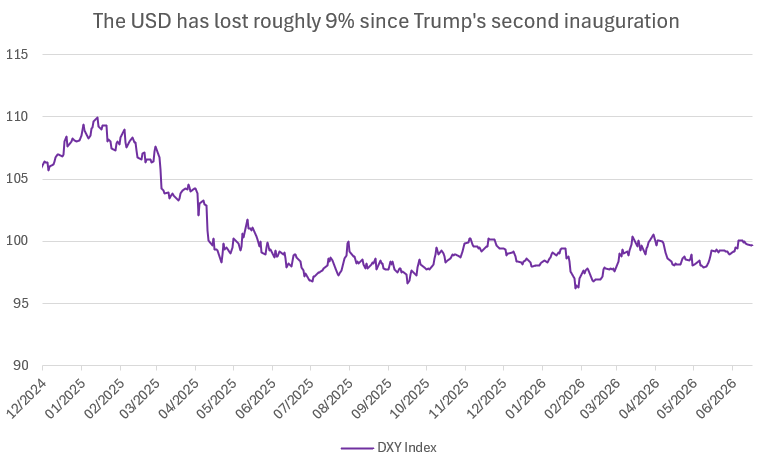
The dollar has received only modest support from a string of positive US data surprises, and from a monetary policy perspective, the repricing of Federal Reserve tightening has remained relatively limited if you compare it to the more pronounced moves on other G10 yield curves.
In the near term, the greenback may continue to benefit from its safe-haven appeal. Further escalation in the Middle East could prove supportive, especially if energy supply conditions deteriorate. Conversely, any meaningful easing of tensions, especially if it facilitates increased flows through the Strait of Hormuz, would likely trigger a relief rally in non‑USD currencies.
Ultimately, the path for the dollar will remain closely tied to inflation dynamics. Any further upside surprises that keep the prospect of additional Fed tightening alive should provide incremental support to the currency, while clearer signs of disinflation would likely weigh on it.
Source: Bloomberg, BIL as of 16 June
Conclusion
As we move into the second half of 2026, the environment is becoming more nuanced. Growth remains resilient but uneven, inflation continues to test policymakers, and geopolitical risks are keeping energy markets volatile. At the same time, market returns are increasingly concentrated, with a narrow set of drivers underpinning returns.
In this context, discipline and adaptability are essential. With the margin for error narrowing, successfully navigating shifting policy expectations and asymmetric risks will be key.
Our approach remains anchored in quality and diversification, while analysing structural growth themes on a more granular level. This includes looking beyond the market leaders to identify less obvious opportunities and second-order beneficiaries.
Favourable conditions may persist, particularly if diplomacy continues to prevail in the Middle East. However, as with any prolonged period of sunshine, SPF protection remains essential. For investors, this means maintaining diversification and implementing downside hedging—especially in more concentrated areas of the market—to guard against potential volatility or a sudden turn in the weather vane.

Disclaimer
All financial data and/or economic information released by this Publication (the “Publication”); (the “Data” or the “Financial data
and/or economic information”), are provided for information purposes only,
without warranty of any kind, including without limitation the warranties of merchantability, fitness for a particular
purpose or warranties and non-infringement of any patent, intellectual property or proprietary rights of any party, and
are not intended for trading purposes. Banque Internationale à Luxembourg SA (the “Bank”) does not guarantee expressly or
impliedly, the sequence, accuracy, adequacy, legality, completeness, reliability, usefulness or timeless of any Data.
All Financial data and/or economic information provided may be delayed or may contain errors or be incomplete.
This disclaimer applies to both isolated and aggregate uses of the Data. All Data is provided on an “as is” basis. None of
the Financial data and/or economic information contained on this Publication constitutes a solicitation, offer, opinion, or
recommendation, a guarantee of results, nor a solicitation by the Bank of an offer to buy or sell any security, products and
services mentioned into it or to make investments. Moreover, none of the Financial data and/or economic information contained on
this Publication provides legal, tax accounting, financial or investment advice or services regarding the profitability or
suitability of any security or investment. This Publication has not been prepared with the aim to take an investor’s particular investment objectives,
financial position or needs into account. It is up to the investor himself to consider whether the Data contained herein this
Publication is appropriate to his needs, financial position and objectives or to seek professional independent advice before making
an investment decision based upon the Data. No investment decision whatsoever may result from solely reading this document. In order
to read and understand the Financial data and/or economic information included in this document, you will need to have knowledge and
experience of financial markets. If this is not the case, please contact your relationship manager. This Publication is prepared by
the Bank and is based on data available to the public and upon information from sources believed to be reliable and accurate, taken from
stock exchanges and third parties. The Bank, including its parent,- subsidiary or affiliate entities, agents, directors, officers,
employees, representatives or suppliers, shall not, directly or indirectly, be liable, in any way, for any: inaccuracies or errors
in or omissions from the Financial data and/or economic information, including but not limited to financial data regardless of the
cause of such or for any investment decision made, action taken, or action not taken of whatever nature in reliance upon any Data
provided herein, nor for any loss or damage, direct or indirect, special or consequential, arising from any use of this Publication
or of its content. This Publication is only valid at the moment of its editing, unless otherwise specified. All Financial data and/or
economic information contained herein can also quickly become out-of- date. All Data is subject to change without notice and may not be
incorporated in any new version of this Publication. The Bank has no obligation to update this Publication upon the availability of new data,
the occurrence of new events and/or other evolutions. Before making an investment decision, the investor must read carefully the terms and
conditions of the documentation relating to the specific products or services. Past performance is no guarantee of future performance.
Products or services described in this Publication may not be available in all countries and may be subject to restrictions in some persons
or in some countries. No part of this Publication may be reproduced, distributed, modified, linked to or used for any public or commercial
purpose without the prior written consent of the Bank. In any case, all Financial data and/or economic information provided on this Publication
are not intended for use by, or distribution to, any person or entity in any jurisdiction or country where such use or distribution would be
contrary to law and/or regulation. If you have obtained this Publication from a source other than the Bank website, be aware that electronic
documentation can be altered subsequent to original distribution.
As economic conditions are subject to change, the information and opinions presented in this outlook are current only as of the date
indicated in the matrix or the publication date. This publication is based on data available to the public and upon information that is
considered as reliable. Even if particular attention has been paid to its content, no guarantee, warranty or representation is given to the
accuracy or completeness thereof. Banque Internationale à Luxembourg cannot be held liable or responsible with respect to the information
expressed herein. This document has been prepared only for information purposes and does not constitute an offer or invitation to make investments.
It is up to investors themselves to consider whether the information contained herein is appropriate to their needs and objectives or to seek advice
before making an investment decision based upon this information. Banque Internationale à Luxembourg accepts no liability whatsoever for any investment
decisions of whatever nature by the user of this publication, which are in any way based on this publication, nor for any loss or damage arising
from any use of this publication or its content. This publication, prepared by Banque Internationale à Luxembourg (BIL), may not be copied or
duplicated in any form whatsoever or redistributed without the prior written consent of BIL 69, route d’Esch ı L-2953 Luxembourg ı
RCS Luxembourg B-6307 ı Tel. +352 4590 6699 ı www.bil.com.
Read more
More
October 8, 2026
BILBoardBIL Board October 2026 – Long-T...
Global bond markets have come under pressure in recent months, pushing long-term yields sharply higher. The US 10-year Treasury yield, potentially one of the most...
October 6, 2026
NewsEurozone Inflation… energy impa...
The Eurozone has so far weathered the energy shock surprisingly well. Yet beneath the surface, rising fuel costs, weaker fiscal support and resilient growth suggest...
October 2, 2026
Weekly Investment Insights
Posted as of midday 2nd October. Thank you for your continued readership. Please note that our weekly insights will pause throughout October, resuming 2nd...
September 28, 2026
Weekly InsightsWeekly Investment Insights
After a volatile week in which stronger-than-expected PMI data fuelled concerns over persistent inflation and higher interest rates, US equities still managed to finish in...
September 21, 2026
Weekly InsightsWeekly Investment Insights
Equities came under pressure at the beginning of last week after leading voices in the AI industry called for a slower pace of technological...